

Scallops are one of the leanest proteins you can buy — and the research people quote about them was done in mice.
A hundred grams of cooked scallops gives 20.5 grams of protein for 111 calories, with under a gram of fat 1. By that measure they are hard to beat. Two other numbers matter and rarely get mentioned: the sodium, and what the studies behind the health claims actually tested.
Key Takeaways
- 20.54 g protein per 100 g cooked, for 111 calories 1.
- Only 0.84 g of fat, of which 0.218 g is saturated 1.
- 667 mg of sodium per 100 g 1 — high for seafood, and the figure worth knowing.
- 2.15 µg of vitamin B12 and 21.7 µg of selenium per 100 g 1.
- The two studies specifically on scallop protein were in mice 67.
Scallop Nutrition
Per 100 grams, cooked by steaming, from USDA FoodData Central 1:
| Nutrient | Per 100 g | Note |
|---|---|---|
| Calories | 111 kcal | About 4 to 5 large sea scallops |
| Protein | 20.54 g | The reason to eat them |
| Total fat | 0.84 g | Very low |
| Saturated fat | 0.218 g | Negligible |
| Sodium | 667 mg | High for seafood |
| Phosphorus | 426 mg | High |
| Potassium | 314 mg | Useful |
| Selenium | 21.7 µg | About 39% of a day |
| Vitamin B12 | 2.15 µg | About 90% of a day |
| Cholesterol | 41 mg | Lower than prawns |
What Scallops Are Actually Good For
Protein with almost nothing attached. 20.5 g of protein and 0.84 g of fat per 100 g 1 is an unusual ratio. Saturated fat is the component with the clearest cardiovascular evidence behind reducing it: a Cochrane review of randomised trials found that cutting saturated fat intake reduced cardiovascular events 3. Scallops carry 0.218 g of it, which is as close to none as a protein food gets.
Protein also matters for ageing bones. A review of the evidence in older adults concluded that higher protein intake is not harmful to bone and may be protective 5. Scallops are an easy way to add protein to a meal without adding fat, in the same way swapping out processed meat changes what comes with the protein.
Vitamin B12, genuinely. 2.15 µg per 100 g 1 is close to a full day’s intake. B12 deficiency has real neurological consequences, and it develops quietly 4. Shellfish are among the densest dietary sources, and this is one of the few claims on this page that needs no hedging — we set out who is actually at risk in our guide to low B12 symptoms.
Selenium. 21.7 µg per 100 g 1 is around 39% of an adult’s daily requirement, from a single modest portion.
What the Scallop Studies Actually Tested
Search for scallop health benefits and you will find two studies quoted as though they were about people. They are worth reading properly, because they are interesting — and because they are about mice.
- In the first, male C57BL/6J mice were fed high-fat, high-sucrose diets for six weeks with protein from chicken, cod, crab or scallop. Only the scallop-fed mice gained less body and fat mass 6.
- In the second, 24 female apoE-deficient mice were fed a Western-type diet for 13 weeks; cod and scallop protein reduced atherosclerotic burden 7.
Both are legitimate early findings and neither is a reason to eat scallops for weight loss or for your arteries. Mouse feeding studies with a single protein source routinely fail to repeat in people, and no human trial has tested scallop protein against another protein for either outcome. The honest claim is the simple one: scallops are a lean, high-protein food, and that is worth something on its own.
Dry Versus Wet Scallops
This is the distinction that decides whether your scallops brown, and most recipes skip it.
Dry scallops are packed as they come. Wet scallops have been held in liquid before packing and carry extra water. In the pan, that water comes straight back out: the temperature drops, the scallop steams in its own liquid, and you get a pale, slightly rubbery result instead of a crust.
How to tell them apart at the counter:
- Dry scallops look slightly off-white or ivory, sometimes faintly pink or orange, and feel tacky.
- Wet scallops look uniformly bright white and often sit in a milky liquid.
- If the label says dry or dry-packed, that is the one you want for searing.
The sodium figure is worth putting next to this: USDA lists cooked scallops at 667 mg of sodium per 100 g 1, which is high for a plain seafood and a reason to keep the rest of the plate unsalted.
Are Scallops Shellfish?
Yes, and the detail matters if you have an allergy. Scallops are molluscs — bivalves, the same broad group as mussels, clams and oysters 1. Prawns, crab and lobster are crustaceans, a different group. Food labelling covers both under shellfish.
Tolerating one group does not reliably predict tolerance of the other in either direction. If you have a diagnosed shellfish allergy, that is a conversation for your allergist rather than something to test at dinner.
Mercury and Safety
Scallops are low in mercury. The FDA and EPA put them on the Best Choices list — the group they advise children and people who are pregnant can eat two to three servings from each week 2. Clams, oysters, shrimp, squid and salmon sit on the same list.
The ordinary cautions apply: buy from a source you trust, keep them cold, cook them through unless you are confident they are sashimi-grade, and do not refreeze thawed scallops.
How to Cook Them
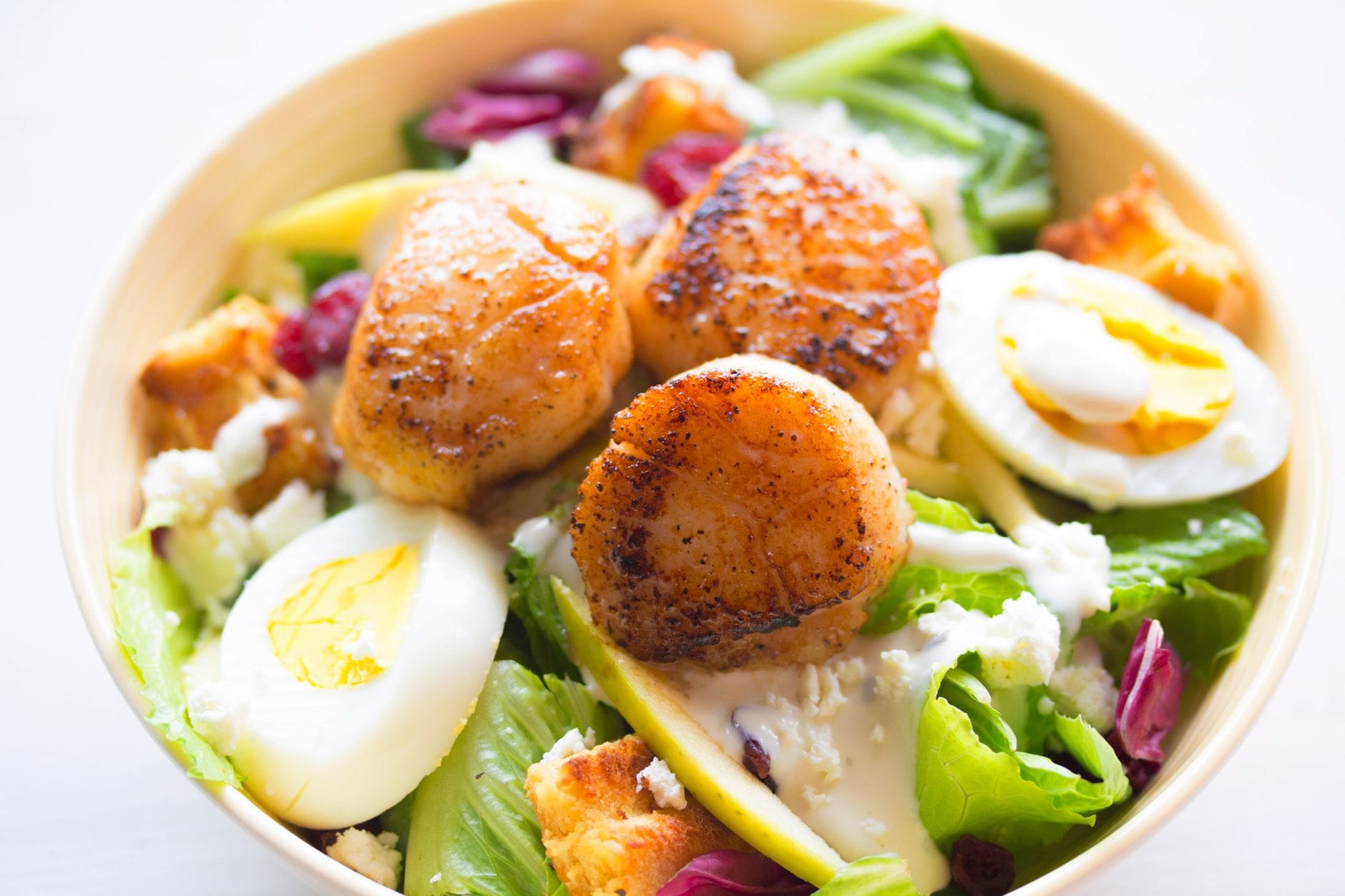 Save
SaveScallops need almost no time, and nearly every failure comes from the same two mistakes: wet scallops, and a pan that is not hot enough.
- Dry them. Pat each one with kitchen paper and leave them uncovered in the fridge for a few minutes if you have time. Surface water is the enemy of a crust.
- Remove the side muscle — the small rectangular tag on the side. It toughens as it cooks and pulls off with your fingers.
- Get the pan properly hot before anything goes in, and use an oil that takes heat.
- Do not crowd the pan. Too many at once drops the temperature and they steam.
- A minute to two a side is usually enough. They are done when the centre is just opaque. Rubbery scallops are overcooked ones.
Frequently Asked Questions
Are scallops healthy?
Yes, as a lean protein they are among the better choices. 100 g of cooked scallops gives 20.5 g of protein for 111 calories, with 0.84 g of total fat and only 0.218 g of it saturated. The one figure to watch is sodium at 667 mg per 100 g, which is high for seafood, so they suit a plate that is otherwise low in salt.
Are scallops shellfish?
Yes, but not the same kind as prawns or crab. Scallops are molluscs, specifically bivalves, while prawns, crab and lobster are crustaceans. Food labelling treats both groups as shellfish. If you have a shellfish allergy, do not assume one group is safe because you tolerate the other, and speak to your doctor before trying.
What is the difference between dry and wet scallops?
Dry scallops are sold as they come out of the shell. Wet scallops have been held in liquid before packing, so they carry extra water. The practical difference shows up in the pan: a wet scallop releases that liquid and steams instead of browning, which is the usual reason a sear fails. Dry scallops look slightly off-white and sticky; wet ones look bright white and sit in milky liquid.
Do scallops have mercury?
Very little. The FDA and EPA place scallops on their Best Choices list, the group of seafood lowest in mercury, which is the list they say children and people who are pregnant can eat two to three servings from each week.
How many calories are in scallops?
About 111 calories per 100 g cooked, which is roughly four to five large sea scallops. Almost all of it is protein: 20.5 g, against 0.84 g of fat.
Why are my scallops rubbery?
Usually overcooking. Scallops are mostly protein and water and need only a minute or two a side in a hot pan. The second cause is starting with wet scallops, which release liquid, drop the pan temperature and end up steamed rather than seared.
The Bottom Line
Scallops are an excellent lean protein: 20.5 g of protein, 111 calories and 0.218 g of saturated fat per 100 g, with most of a day’s B12 and about 39% of its selenium 1. They are low in mercury 2. The sodium is the figure to keep an eye on at 667 mg. And the studies you will see quoted about scallop protein preventing obesity and atherosclerosis were done in mice 67 — good science, not yet a reason to change what you eat. Buy dry-packed, dry them properly, and keep them in the pan for two minutes, not five.
Related Articles
The Homemade Protein Shakes I Reach For Instead of Store-Bought Powder
Can Fish Oil Actually Help You Lose Weight? Here’s What the Research Says
What to Eat When You’re Trying to Get Pregnant
Light Food Recipes That Fill You Up Without Weighing You Down