
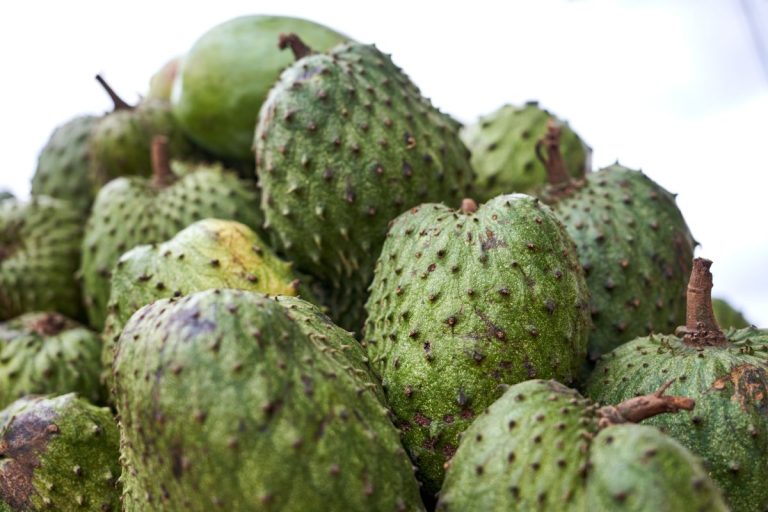
Soursop is a genuine food with a genuine problem, and the problem is not the one the internet argues about. It is not about cancer. It is about nerves, and about how often you have it.
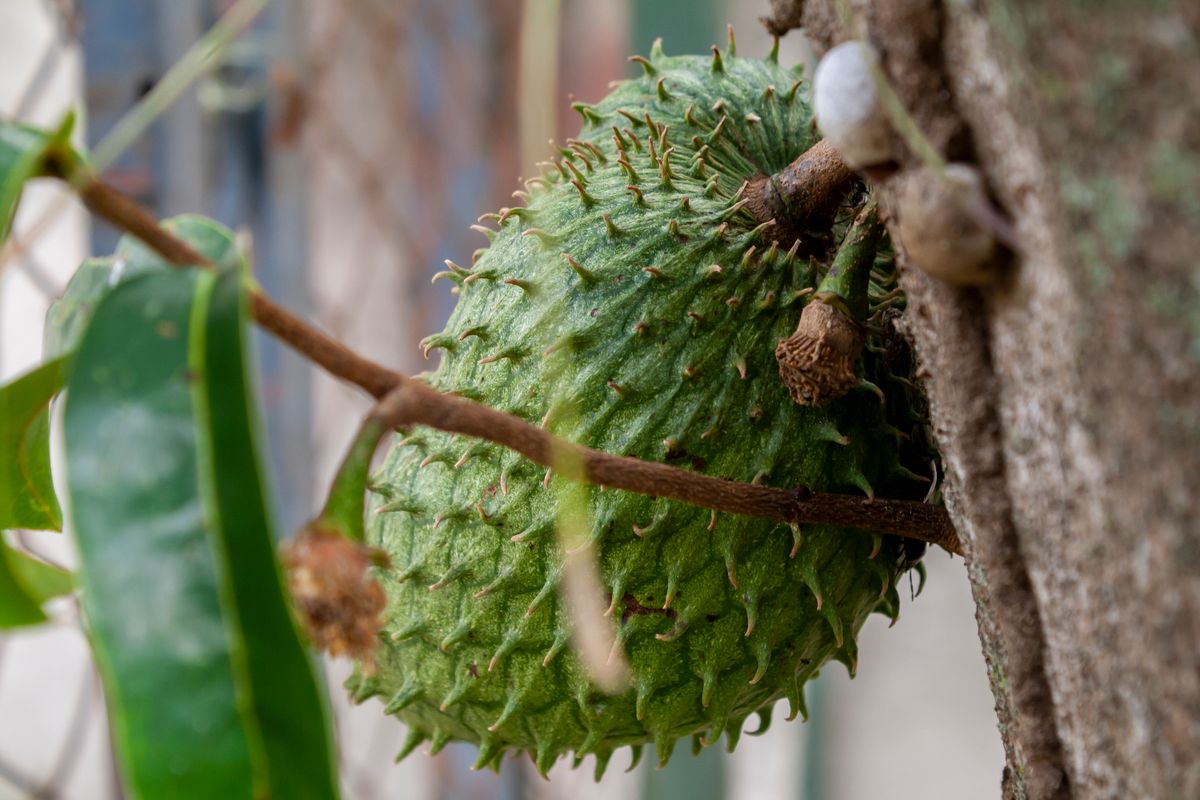
Soursop, also sold as graviola or guanabana, is a large green fruit with soft spines and sweet white flesh. It is eaten across the Caribbean, West Africa, South America and Southeast Asia, and it is sold online as capsules, extracts and dried leaves on the promise that it treats cancer.
The fruit itself is fine food. What deserves attention is a compound called annonacin, the research from Guadeloupe, and one finding from 2022 that changes the practical advice.
Key Takeaways
- Soursop contains annonacin, which blocks complex I of the mitochondrial energy chain in nerve cells (5).
- In Guadeloupe, where soursop is widely eaten, an unusual pattern of parkinsonism has been studied for years, with annonacin as the leading candidate cause (2).
- An average fruit holds about 15 mg of annonacin; a can of nectar about 36 mg; a cup of leaf tea about 140 micrograms (1).
- A 2022 study found that even low cumulative intake of the fruit or juice, and any intake of the leaf tea, was linked to worse symptoms in people who already had parkinsonism (3).
- The European Food Safety Authority reported substantial uncertainty about the safety of Annona muricata supplements (4).
- No safe limit has been published by anyone. This page does not invent one.
What Is Actually in the Fruit
Before the problem, the ordinary part. Per 100 g of raw soursop (6):
| Per 100 g, raw | Amount |
|---|---|
| Energy | 66 kcal |
| Carbohydrate | 16.8 g, of which 13.5 g sugars |
| Fibre | 3.3 g |
| Vitamin C | 20.6 mg |
| Potassium | 278 mg |
| Magnesium | 21 mg |
| Protein / fat | 1.0 g / 0.3 g |
A decent fruit: fibre, vitamin C, potassium, not much else. Nothing here explains the reputation it has been given, in either direction.
 Save
SaveThe Compound That Matters
Soursop belongs to the Annonaceae family, which produces a group of compounds called acetogenins. The main one in soursop is annonacin.
Annonacin is a lipophilic inhibitor of complex I of the mitochondrial respiratory chain. In plain terms, it interferes with the way cells generate energy, and nerve cells are particularly dependent on that. In laboratory work, annonacin given to rats caused degeneration of neurons in the brain regions affected in parkinsonism (5).
Being lipophilic matters: it crosses into the brain rather than being flushed out.
What Was Found in Guadeloupe
Guadeloupe has an unusually high rate of atypical parkinsonism. In a study of 160 patients there, only about 31% had classical Parkinson’s disease. Roughly a third had a syndrome resembling progressive supranuclear palsy, and another third had a parkinsonism-dementia pattern that did not fit existing categories (2).
Soursop, eaten as fruit and drunk as leaf infusions, emerged as the leading candidate explanation. It is important to be straight about what that means: this is an association studied over years, not a proven cause. The researchers themselves describe annonacin as a candidate aetiological factor (2).
How Much Annonacin Is in a Fruit, a Can, a Cup
This is the part almost nothing else on the subject gives you. Researchers measured the actual amounts (1):
| What you consume | Annonacin | Worth knowing |
|---|---|---|
| One average fruit | about 15 mg | The usual serving in a household |
| One can of commercial nectar | about 36 mg | More than twice a fruit, and easier to drink often |
| One cup of leaf infusion | about 140 micrograms | Roughly a hundredth of a fruit, but drunk daily for months |
The authors added a comparison to show the scale: an adult who ate one fruit or drank one can of nectar a day would take in, over a year, the quantity of annonacin that produced brain lesions in rats given purified annonacin by intravenous infusion (1).
Read that carefully, because it is easy to misuse in both directions. The rats received it intravenously and purified, which is not the same as eating fruit. The authors present it as an indication of potential toxicity, not as a human dose. It is still a sobering way to look at a daily habit.
The 2022 Finding That Changed the Advice
Until recently the working assumption was that heavy, long-term consumption was the concern. A 2022 study of 180 Caribbean patients with degenerative parkinsonism looked for a dose effect of lifelong consumption, and found one at a lower level than expected (3):
- Even low cumulative intake of fruit or juice was associated with greater disease severity and cognitive problems
- Any reported consumption of Annonaceae herbal tea was associated with the same
- The authors concluded that more restrictive public health recommendations should be made
Two cautions. This was in people who already had parkinsonism, so it speaks to worsening an existing disease more directly than to causing one in a healthy person. And it relies on people recalling decades of eating habits, which is never precise. Even so, it is the reason the leaf tea deserves more caution than the fruit, not less.
Why the Leaves Are the Bigger Question
This runs against almost everything written about soursop, where the leaf tea is presented as the gentle, natural option.
A cup of infusion contains roughly a hundredth of the annonacin in a fruit (1). But nobody eats a fruit every day for six months, and plenty of people drink a herbal tea that way. In the 2022 data it was the tea, not the fruit, where any consumption at all showed an association (3).
Concentrated capsules and extracts are a step further again. The European Food Safety Authority assessed Annona muricata food supplements and found substantial uncertainty about their safe use, with indications of neurotoxic potential and very little long-term data (4).
About the Cancer Claims
This is why most people search for soursop in the first place, so it deserves a direct answer rather than a polite one.
There is laboratory and animal research on soursop extracts and cancer cells. There are no human trials showing that soursop treats cancer. The supplement market built on that research is selling concentrated acetogenins, which is exactly the part with the documented neurotoxic signal (4).
So the trade is an unproven benefit against a measured risk. Anyone being treated for cancer should raise supplements with their oncologist before taking them, because interactions with treatment are a separate question again.
Who Should Be Most Careful
- Anyone with Parkinson’s disease or another movement disorder. This is the clearest signal in the data (3)
- Anyone drinking the leaf tea regularly, rather than eating the fruit occasionally
- Anyone taking graviola capsules or extracts
- Pregnancy and breastfeeding, where there is no safety data worth the name
- Children, for the same reason
So Can You Eat Soursop?
Yes, and the honest framing is about frequency rather than prohibition. Millions of people eat this fruit and the research is about long-term, habitual intake, not about a slice at a market.
What the evidence supports in practice:
- Eat the fresh fruit occasionally, not daily
- Treat juice and canned nectar as the same thing as fruit, or more — a can holds over twice the annonacin of an average fruit (1)
- Be more careful with leaf tea than with the fruit, not less
- Skip concentrated supplements
- If you have a neurological condition, ask your doctor rather than this page
Frequently Asked Questions
Is soursop poisonous?
Not in the way an unripe ackee or a raw kidney bean is. Soursop will not make you ill the day you eat it. The concern is different and slower: the fruit and especially the leaves contain annonacin, a compound that blocks part of how nerve cells make energy, and long-term heavy consumption has been linked to an unusual form of parkinsonism in the Caribbean. An occasional fruit is a different proposition from a daily habit.
Are soursop leaves toxic?
The leaves are the part to be most careful with, which is the opposite of what most websites suggest. A cup of leaf infusion contains far less annonacin than the fruit does, but in a study of 180 Caribbean patients with degenerative parkinsonism, any reported consumption of Annonaceae herbal tea was associated with worse disease severity and cognitive problems. Tea is also something people drink daily and for months, which fruit usually is not.
How much soursop is too much?
Nobody has published a safe limit, and we are not going to invent one. What exists is a comparison: researchers estimated that an adult eating one fruit or one can of nectar a day would take in, over a year, the amount of annonacin that caused brain lesions in rats given it intravenously. That is an indication of scale rather than a dose, because the route and the species are different, but it argues strongly against a daily habit.
Does soursop cure cancer?
No, and nobody has shown that it treats cancer in people. Laboratory and animal studies on extracts are what the marketing is built on; there are no human trials demonstrating benefit. Meanwhile the European Food Safety Authority looked at Annona muricata supplements and reported substantial uncertainty about their safety, with indications of neurotoxic potential. Buying a concentrated extract is taking the known risk in exchange for an unproven benefit.
Can you eat soursop occasionally?
The evidence is about habitual, long-term intake rather than single servings, and millions of people eat the fruit without any recorded harm. If you want to be careful: eat the fresh fruit occasionally rather than daily, treat juice and nectar as the same thing as fruit, be more cautious with leaf tea than with the fruit, and avoid concentrated supplements altogether. Anyone with Parkinson’s disease or another movement disorder should talk to their neurologist first.
The Bottom Line
Soursop is not poisonous in the ordinary sense. You will not be ill tomorrow because you ate one. What it carries is a slow, specific risk to nerve cells, studied for decades in a place where people eat a great deal of it, and strong enough that researchers have called for more restrictive advice rather than less (3).
The practical conclusion is unusually clear for a food story: the fruit occasionally is one thing, the daily leaf tea and the capsules are another. Most writing about soursop has that exactly backwards.
This article is for information only and is not medical advice. If you have Parkinson’s disease, another neurological condition, or you are being treated for cancer, discuss soursop with your doctor before taking it in any concentrated form.
Related Articles
Giloy Side Effects: What the Liver Injury Reports Show
Is Ackee Poisonous? Unripe Fruit, Symptoms and Safe Eating
Turkey Berry Side Effects, Disadvantages and Benefits
Cassava Flour: Nutrition, Safety and Real Comparisons