
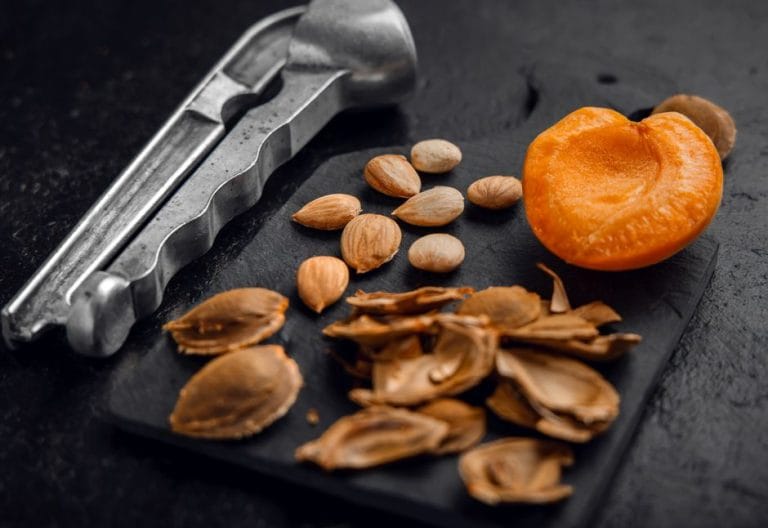
Apricot seeds are sold as a health food. The regulator’s own limit works out at less than one bitter kernel for a grown adult.
Apricot seeds — the kernel inside the hard stone — turn up in health shops, in bags marked vitamin B17, and in advice that ranges from harmless to dangerous. The numbers behind them are unusually clear, and they are not reassuring.
Key Takeaways
- EFSA’s acute limit for cyanide is 20 micrograms per kg of body weight (1).
- For a 70 kg adult that is reached at roughly 0.4 g of bitter kernel (1)(2).
- Blood cyanide peaked 20 minutes after bitter kernels — fastest of any food tested (2).
- Cochrane on the cancer claim: the risk-benefit balance is unambiguously negative (3).
- 14 children were treated in one intensive care unit over five years (4).
- Measured amygdalin in bitter kernels ranged 5,530 to 24,000 µg/g; in sweet kernels 31 to 296 (6).
How Many Apricot Seeds Are Dangerous?
| Figure | Source | |
|---|---|---|
| Acute reference dose for cyanide | 20 micrograms per kg of body weight, whatever the food it comes from | EFSA (1) |
| That limit for a 70 kg adult | 1.4 mg of cyanide in one sitting | calculated from (1) |
| Cyanide in bitter apricot kernels | About 3,250 mg per kg, or 3.25 mg in a single gram — one measured value, not a fixed property | (2) |
| How much bitter kernel reaches the limit | Roughly 0.4 g — well under one kernel | calculated from (1)(2) |
| Long-term safe intake | No value could be established from the available data | EFSA (1) |
In 2016 EFSA set an acute reference dose of 20 micrograms of cyanide per kilogram of body weight, and in 2019 the panel confirmed that this figure applies to acute effects of cyanide regardless of the dietary source (1).
For someone weighing 70 kg, that is 1.4 milligrams of cyanide in a single sitting.
Now the other half. A human study that fed volunteers cyanogenic foods measured bitter apricot kernels at about 3,250 mg of total cyanide equivalent per kilogram (2) — 3.25 mg in every gram.
Divide one by the other and you get roughly 0.4 of a gram of bitter kernel before an adult is at the acute limit. That is not a handful. It is a fraction of a single kernel. That figure rests on a single measured average, and cyanogenic content varies widely between kernels, so treat it as the middle of a range rather than a line drawn in one place.
A child reaches it much sooner, because the dose is per kilogram of body weight. That is the same arithmetic that makes children the vulnerable group for green and sprouting potatoes.
Bitter vs Sweet Apricot Kernels: Which One Is in the Bag?
| What the bag says | Amygdalin measured | Samples |
|---|---|---|
| Labelled bitter | 5,530 to 24,000 µg/g | 8 |
| Labelled sweet | 31 to 296 µg/g | 5 |
| No flavour label at all | 51 to 848 µg/g | 3 |
| Ordinary almonds, for comparison | 2.6 µg/g, and one below the limit of quantitation | 2 |
Everything above concerns bitter kernels. Sweet ones are a different product, and the distance between them is the most important thing on this page after the dose itself.
Scientists at the US Food and Drug Administration measured amygdalin in 18 retail products by LC-MS/MS (6). The results split three ways.
Kernels labelled bitter ran from 5,530 to 24,000 micrograms per gram (6) — a spread of more than fourfold between products sitting on the same shelf.
Kernels labelled sweet ran from 31 to 296 micrograms per gram (6). Depending on which two bags you compare, that is somewhere between 20 and 800 times less.
The ones sold with no flavour label measured 51 to 848 micrograms per gram (6), landing between the two. If the bag does not say, the number cannot be guessed from the outside.
Two things follow. Sweet kernels are not the product this article warns about, and the arithmetic above does not transfer to them. And the 0.4 g figure is a midpoint, not a threshold: within that measured range, a kernel from the high end carries more than four times the amygdalin of one from the low end. The limit is fixed. The kernel is not.
One caution about mixing the two studies. The FDA work measured amygdalin; the feeding study behind the 0.4 g figure measured total cyanide equivalent. Those are different quantities and cannot be swapped one for the other, so the range above is evidence of how much kernels vary — not a recalculation of the dose.
Ordinary almonds are not part of this conversation at all, at 2.6 micrograms per gram and below (6). Bitter almonds are a separate case.
Apricots are not alone in this either. The same cyanogenic chemistry sits in the seeds and cores of crab apples, and in the seeds of the medlar, which should not be eaten at all. In each case it is the seed rather than the fruit that carries the caution.
How Quickly Cyanide From Apricot Kernels Reaches the Blood
 Save
Save| Food eaten | Peak cyanide in blood | Time to peak |
|---|---|---|
| Bitter apricot kernels | 14.3 µM | 20 minutes |
| Fresh cassava root | 15.4 µM | 37.5 minutes |
| Linseed | 5.7 µM | 40 minutes |
| Persipan paste, 100 g | 1.3 µM | 105 minutes |
Twelve healthy adults ate four different cyanogenic foods, each portion containing the same 6.8 mg of cyanide equivalent, and had their blood measured repeatedly (2).
Cassava reached the highest peak, but bitter apricot kernels reached almost the same level in half the time — 14.3 micromolar after just 20 minutes (2).
That speed is the practical danger. Cyanide’s toxicity depends on the peak level reached, not the total swallowed, so a dose released quickly hits harder than the same dose released slowly. Linseed delivered the identical amount of cyanide and peaked at 5.7 micromolar, under half as high, because it released it gradually (2). The same principle applies to cassava and how it is processed.
Do Apricot Seeds Cure Cancer? What the Evidence Says
Apricot kernels are sold as laetrile, amygdalin or vitamin B17, and the marketing is built on a cancer claim. A Cochrane review went looking for the evidence.
The authors searched eight databases and two registers, located over 200 references, and found that not one study met the inclusion criteria (3).
Their conclusion, in their own words: the claims are not currently supported by sound clinical data, there is a considerable risk of serious adverse effects from cyanide poisoning, especially after oral ingestion, and the risk-benefit balance is unambiguously negative (3).
Cochrane reviews are usually written in careful hedges. That sentence is not a hedge.
Worth adding that vitamin B17 is not a vitamin. It is a marketing name for a cyanogenic glycoside, and no deficiency of it exists.
Apricot Seed Poisoning Symptoms
A paediatric intensive care unit in Turkey reviewed five years of admissions and reported 14 children aged 1 to 18 treated for suspected cyanide poisoning after eating apricot kernels and bitter almonds (4).
The pattern is worth knowing because the early signs are vague:
- Weakness and fatigue were the commonest presenting symptoms, in 7 of the 14 (4).
- Four developed blue discolouration of the lips (4).
- Three had an altered level of consciousness (4).
- Vomiting, seizures, headache, dizziness and palpitations appeared less often (4).
- Four needed hydroxocobalamin as an antidote because of acidosis (4).
All 14 were discharged (4). The peak month was July, coinciding with the agricultural season (4).
Tiredness and weakness after a summer snack is not an obvious emergency, which is exactly why the history matters. If someone has eaten kernels and then feels weak, say so at the hospital.
Can Dogs Eat Apricot Kernels?
A veterinary case report describes a 9.5-year-old Golden Retriever that vomited and collapsed after eating apricot kernel meal, with laboratory findings consistent with cyanide toxicity (5). It was treated with hydroxocobalamin, deteriorated regardless, and did not survive (5).
If there is a bag of kernels in the house and a dog in the same room, that is worth moving today.
Frequently Asked Questions
Are apricot seeds poisonous?
The kernel inside the stone contains amygdalin, which releases cyanide once it is chewed and digested. EFSA set an acute reference dose for cyanide of 20 micrograms per kilogram of body weight and concluded that this figure applies regardless of which food the cyanide comes from. For an adult of 70 kilograms that is 1.4 milligrams in one sitting. Measured bitter apricot kernels carry around 3,250 milligrams of cyanide equivalent per kilogram, which works out at about 0.4 of a gram of kernel to reach that limit. That is less than one kernel, which is why this is not a food where a rough guess is good enough.
Are sweet apricot kernels safe to eat?
Sweet and bitter kernels are not the same product, and the measured gap is large. Scientists at the US Food and Drug Administration analysed 18 retail products and found amygdalin ranging from 5,530 to 24,000 micrograms per gram in kernels labelled bitter, against 31 to 296 micrograms per gram in kernels labelled sweet. Kernels sold with no flavour label measured 51 to 848 micrograms per gram, which means the bag itself is the only clue and sometimes it does not give one. Sweet kernels are far lower in amygdalin, so the dose arithmetic for bitter kernels does not apply to them, but an unlabelled bag is not a sweet bag.
How many apricot seeds are dangerous?
Fewer than most people assume, and the honest answer is that it depends on the kernel and on body weight rather than on a fixed count. Working from EFSA’s acute reference dose and the measured cyanide content of bitter kernels, an adult reaches the limit at roughly 0.4 grams of kernel. A child reaches it far sooner, because the dose is set per kilogram of body weight. A case series from a paediatric intensive care unit in Turkey followed 14 children aged 1 to 18 admitted with suspected cyanide poisoning after eating apricot kernels and bitter almonds over a five-year period.
Is vitamin B17 a real vitamin?
No. Vitamin B17 is a marketing name for amygdalin, the cyanogenic glycoside in bitter apricot kernels, also sold as laetrile. It is not a vitamin, no deficiency of it exists, and a Cochrane review searching eight databases found not a single study that met its inclusion criteria for treating cancer. The risk-benefit balance was described as unambiguously negative.
Do apricot seeds cure cancer?
No, and this is one of the few questions in nutrition with a genuinely settled answer. A Cochrane review searched eight databases and two registers for trials of laetrile or amygdalin in cancer, located over 200 references, and found that not a single study met the inclusion criteria. Its conclusion was that the claimed benefits are not supported by sound clinical data, that there is a considerable risk of serious adverse effects from cyanide poisoning, especially after swallowing it, and that the risk-benefit balance is unambiguously negative. That is unusually blunt language for a Cochrane review.
What does apricot seed poisoning feel like?
In the paediatric case series the most common symptoms on arrival were weakness and fatigue, reported in 7 of the 14 children. Four developed blue discolouration of the lips and three had an altered level of consciousness. Vomiting, seizures, headache, dizziness and palpitations appeared less often. Four children needed hydroxocobalamin as an antidote because of acidosis on their blood gases. All 14 were discharged. The onset is fast: in a human study, blood cyanide after bitter apricot kernels peaked at 20 minutes, sooner than for any other cyanogenic food tested.
Is apricot kernel oil or marzipan a risk too?
Those are different products and the picture is much calmer. The same human study measured persipan paste, a marzipan-style paste made with apricot or peach kernels, and found a peak blood cyanide level of 1.3 micromolar after 100 grams, roughly a tenth of what the raw bitter kernels produced, and it arrived after 105 minutes rather than 20. Processing and the absence of active enzyme make the difference. The concern attaches to raw bitter kernels eaten deliberately, not to traces in processed foods.
Can dogs eat apricot kernels?
They should not, and there is a published case showing why. A veterinary report describes a 9.5-year-old Golden Retriever that vomited and collapsed after eating apricot kernel meal, with a high anion gap metabolic acidosis and severe hyperlactataemia consistent with cyanide toxicity. The dog was given hydroxocobalamin as an antidote, deteriorated anyway, and did not survive. If a dog gets into apricot kernels or a bag of kernel meal, that is an emergency call to a vet rather than something to watch at home.
The Bottom Line
Apricot seeds are one of the few foods where the safe amount is smaller than a single piece. EFSA’s acute reference dose of 20 micrograms of cyanide per kilogram of body weight, set against the measured 3,250 mg per kilogram in bitter kernels, puts an adult’s limit at around 0.4 of a gram, and a child’s far lower. Measured amygdalin in bitter kernels spans more than fourfold between products, so that gram figure is a midpoint rather than a guarantee. The cyanide arrives fast, peaking in the blood within 20 minutes, which matters more than the total dose because toxicity tracks the peak. The cancer claim that sells them has been examined by Cochrane, which found no qualifying studies at all and called the risk-benefit balance unambiguously negative. EFSA could not even establish a long-term safe intake from the available data. There is no version of this where eating them by the handful is a reasonable thing to do.
This article is for informational purposes only and is not a substitute for professional medical advice. If you suspect cyanide poisoning, treat it as an emergency and seek immediate medical help. In the United States the Poison Help hotline is 1-800-222-1222; elsewhere, contact your local poison centre or emergency service.
Related Articles
Cassava Flour: Nutrition, Safety and Real Comparisons
Sprouted Potatoes: When They Are Safe to Eat
Aluminum Foil: What Leaches Into Your Food
Processed Meat and Cancer: What Group 1 Really Means