
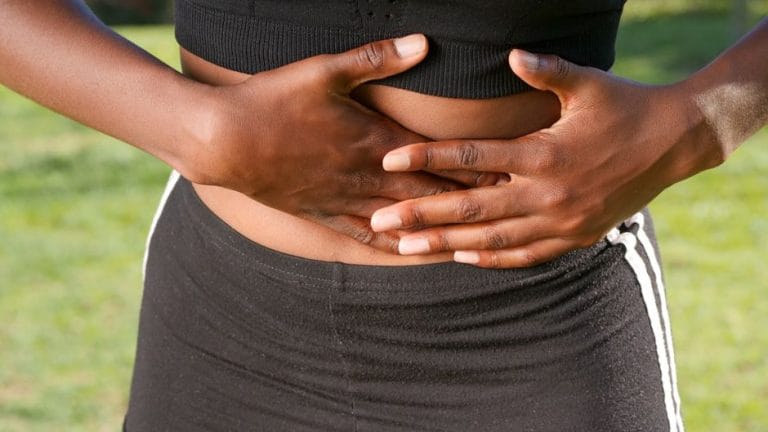
The bloating aisle is full of probiotics. The largest American gastroenterology body says not to use them for this. What did work in a trial was a short walk.
Bloating is one of the commonest reasons people visit a gastroenterologist, and one of the most heavily marketed-to symptoms there is. The trial evidence points somewhere quite different from the shelf.
Key Takeaways
- A 10 to 15 minute walk after meals beat prokinetic medication in a randomised trial (3).
- The AGA advises probiotics should not be used for bloating and distension (2).
- Low FODMAP ranked first of all interventions in a 13-trial network meta-analysis (1).
- Standard dietetic advice was not superior to any other intervention (1).
- Visible distension can be muscle activity, not gas (2)(5).
Bloating: What The Trials Actually Tested
| Approach | What was found | Verdict |
|---|---|---|
| A 10 to 15 minute walk after each meal | In a 4-week randomised trial it beat prokinetic medication for post-meal fullness and bloating (p = 0.002) (3) | Do this first |
| Low-FODMAP approach | Ranked first of all interventions in a network meta-analysis of 13 trials, and beat standard dietetic advice for bloating specifically (1) | Works, but get help |
| Probiotics | The American Gastroenterological Association advises they should not be used to treat bloating and distension (2) | Do not bother |
| Standard dietary advice (NICE/BDA) | Not superior to any other intervention in any analysis (1) | Weak |
| Routine scans and gastric emptying tests | Should not be ordered routinely, only with alarm features (2) | Not needed first |
The Cheapest Thing On The List Won
 Save
SaveNinety-four people with functional bloating were randomised into two groups for four weeks (3).
One group took domperidone plus activated dimethicone, the conventional drug approach. The other group simply walked for 10 to 15 minutes after each meal (3).
Both improved significantly on belching, flatus, post-meal fullness, gas incontinence and abdominal discomfort (3). Between the groups, most differences were not statistically significant — except one.
For post-meal fullness and bloating, walking was superior to the medication, with a p-value of 0.002 (3).
The mechanism was measured separately and much earlier. Eight healthy adults had gas infused directly into the small intestine while researchers tracked how much stayed put. Gas retention was significantly lower during mild pedalling than at rest — minus 84 mL versus plus 143 mL (4). Measured abdominal girth followed: 3 mm of distension during exercise versus 8 mm at rest (4).
Mild movement moves gas. That is the whole finding, and it costs nothing.
The Diet That Ranked First
| Comparison | Relative risk of symptoms NOT improving | Meaning |
|---|---|---|
| Low FODMAP vs your usual diet | 0.67 (95% CI 0.48 to 0.91) | About a third fewer people left unimproved |
| Low FODMAP vs standard dietetic advice | 0.72 (95% CI 0.55 to 0.94) | Better for bloating specifically |
| Standard dietetic advice vs anything else | no significant advantage | Did not beat a single comparator |
A network meta-analysis pooled 13 randomised controlled trials covering 944 patients and ranked every intervention against every other (1).
A low-FODMAP diet ranked first for all endpoints studied, including abdominal bloating and distension severity (1). Against a habitual diet, the relative risk of symptoms not improving was 0.67 (1).
More striking is the comparison with official dietary advice. Low FODMAP was superior to BDA and NICE dietary advice for bloating and distension (RR 0.72, 95% CI 0.55 to 0.94), and that standard advice was not superior to any other intervention in any analysis (1).
Two honest caveats from the authors themselves. Most trials were run in secondary or tertiary care, meaning the patients were already referred specialists’ cases, and the trials did not study the reintroduction and personalisation phases (1). A low-FODMAP diet is not meant to be permanent, and the AGA update advises that when it is used, a gastroenterology dietitian should preferably monitor it (2). It restricts a lot of otherwise good food, so keeping the overall diet balanced matters while you do it.
The Sentence Worth Quoting
Among the fifteen best-practice statements in the AGA’s clinical practice update on belching, bloating and distension is this one, unhedged:
Probiotics should not be used to treat abdominal bloating and distention (2).
That is the American Gastroenterological Association, in Gastroenterology, about the single product category most sold for this symptom.
What the same document does support includes dietary modification with dietitian supervision, biofeedback where a pelvic floor disorder has been identified, psychological therapies such as hypnotherapy and cognitive behavioural therapy, central neuromodulators, and treating constipation where constipation is present (2).
Why Your Stomach Looks Swollen
This part explains something people find genuinely confusing: the abdomen visibly sticking out without a matching amount of gas.
Reviews of bloating describe abdominal wall muscle activity as one of the operative mechanisms, which is why controlling it via biofeedback appears among the treatment options (5). The AGA update names the pattern directly — abdominophrenic dyssynergia — and lists diaphragmatic breathing as a treatment for it (2).
In plain terms: the diaphragm pushes down while the abdominal wall relaxes outward, and the belly protrudes. It is a reflex, not a volume.
When It Stops Being A Diet Question
The AGA update is also useful for what it tells you not to chase.
Abdominal imaging and upper endoscopy are reserved for alarm features, recent worsening symptoms, or an abnormal examination (2). Gastric emptying studies should not be ordered routinely for bloating, though they may be considered if nausea and vomiting are present (2).
Two things are worth ruling out properly rather than guessing at. Coeliac disease can be excluded with serologic testing, confirmed by small bowel biopsy if positive (2) — and cutting out gluten before testing makes that harder. Carbohydrate enzyme deficiencies may be ruled out with dietary restriction or breath testing (2).
Frequently Asked Questions
What actually reduces bloating?
Two things have real trial support, and one of them is free. In a four-week randomised trial, 94 people with functional bloating were assigned either a 10 to 15 minute walk after every meal or prokinetic medication with activated dimethicone. Both groups improved significantly, and for post-meal fullness and bloating specifically the walking group did better than the medication, with a p-value of 0.002. The other is the low-FODMAP approach, which ranked first among all interventions in a network meta-analysis of 13 randomised trials covering 944 patients. For the wider link between the gut and how you feel, see gut health and mental health.
Do probiotics help with bloating?
The American Gastroenterological Association’s clinical practice update on belching, bloating and distension is unusually direct on this point: probiotics should not be used to treat abdominal bloating and distention. That is one of fifteen best-practice statements in the document. It is worth knowing because bloating is one of the most common reasons probiotics are bought. The same update does support other approaches, including dietary modification with a gastroenterology dietitian monitoring it, biofeedback where a pelvic floor disorder is identified, and psychological therapies such as hypnotherapy and cognitive behavioural therapy.
Why does my stomach look bigger when I am bloated?
Because bloating and visible distension are not the same thing, and the second one often involves muscle rather than gas. Reviews of the field describe abdominal wall muscle activity as one of the mechanisms behind visible distension, which is why controlling that activity through biofeedback is among the treatment approaches. The AGA update names abdominophrenic dyssynergia specifically, and lists diaphragmatic breathing as a treatment for it. So the abdomen can protrude because the diaphragm pushes down and the abdominal wall relaxes, not because there is dramatically more gas inside.
Does walking after eating really help?
There is both a trial and a mechanism. The trial found a 10 to 15 minute post-meal walk outperformed prokinetic medication for post-meal fullness and bloating over four weeks. The mechanism was measured separately: in eight healthy adults, gas was infused into the small intestine and gas retention was significantly lower during mild pedalling than at rest, minus 84 millilitres versus plus 143 millilitres. Measured abdominal distension was also lower during exercise, 3 millimetres versus 8 at rest. Mild movement moves gas along.
Should I cut out gluten or dairy for bloating?
Not as a first step, and not without ruling things out properly. The AGA update advises that serologic testing may be used to rule out coeliac disease in patients with bloating, and that if those tests are positive a small bowel biopsy should confirm it. Cutting gluten out before testing can make coeliac disease harder to diagnose. The update also notes that carbohydrate enzyme deficiencies may be ruled out with dietary restriction or breath testing. The point is that self-elimination replaces information you might need.
When should I see a doctor about bloating?
The AGA update reserves abdominal imaging and upper endoscopy for patients with alarm features, recent worsening of symptoms, or an abnormal physical examination, which is a reasonable guide to when this stops being a self-management question. Bloating that is new and persistent, getting worse, or comes with weight loss, vomiting, bleeding or a change in bowel habit deserves assessment. Routine gastric emptying studies are specifically not recommended for bloating alone, though they may be considered if nausea and vomiting are present.
The Bottom Line
Bloating has a marketing problem. The product most sold for it, probiotics, is the one the American Gastroenterological Association explicitly advises against using for it. The intervention with the best trial ranking is a low-FODMAP approach, which came first across all endpoints in a network meta-analysis of 13 trials and beat standard dietetic advice for bloating specifically — though it needs dietitian supervision and is not meant to be permanent. And the cheapest option has direct evidence behind it: a 10 to 15 minute walk after meals outperformed prokinetic medication for post-meal bloating in a four-week trial, with a measured mechanism showing that mild activity clears intestinal gas faster than rest A narrower complaint, gas rather than bloating, has its own evidence: see fennel tea.. Visible distension, meanwhile, is often abdominal wall muscle behaviour rather than gas volume.
This article is for informational purposes only and is not a substitute for professional medical advice. See a doctor for bloating that is new and persistent, worsening, or accompanied by weight loss, vomiting, bleeding or a change in bowel habit, and do not start an elimination diet for suspected coeliac disease before being tested.
Related Articles
High Fiber Foods List and How Much Fiber You Need
Balanced Diet Guide With the 5 Food Groups
Home Remedies for Diarrhea: Rehydration and When to Worry
Low-Glycemic Diet: GI Food List, Benefits and Limits