
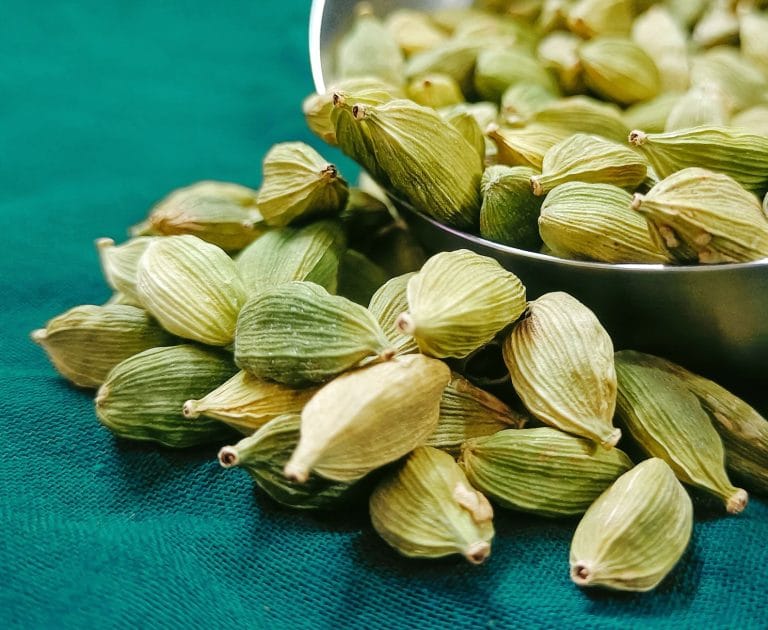
Which health benefits of cardamom hold up in pooled human trials, how big the effects actually are, and the claims we have taken off this page.
Cardamom is a genuinely good spice with a genuinely inflated reputation. The previous version of this article credited it with helping digestion, cholesterol, blood pressure, detoxification and cancer prevention, and attributed advice to two people we could not verify exist.
It also cited two studies for its cancer section. Both were experiments on chemically induced skin tumours in mice (5, 6).
Since then, enough human randomised trials have been run to pool, so this page has been rebuilt on those instead.
Key Takeaways
- The one consistent finding is lower triglycerides, across two meta-analyses (2, 3).
- No significant effect on total cholesterol, LDL or HDL (2, 3).
- Diastolic blood pressure fell by 0.91 mmHg. Systolic did not move (1).
- One meta-analysis found BMI increased, so the weight claim is gone (3).
- The cancer studies were in mice (5, 6).
What Cardamom Is
 Save
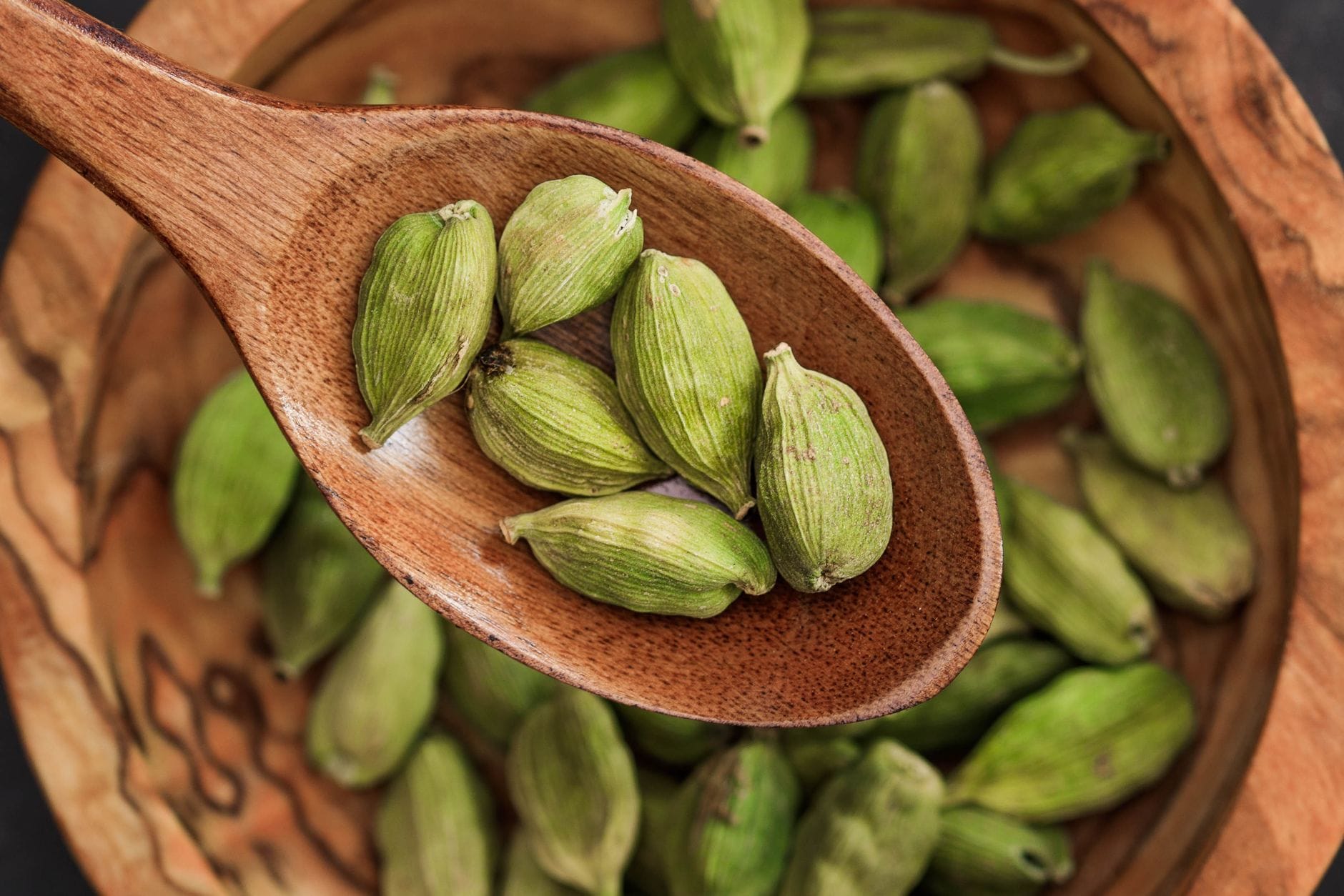
SaveCardamom is the dried seed pod of plants in the ginger family, Zingiberaceae. Green cardamom is the common variety, used in both sweet and savoury cooking. Black cardamom is smokier and mostly savoury.
Per 100 g, ground cardamom looks spectacular on paper: 28 g of fibre, 383 mg of calcium, 229 mg of magnesium, 14 mg of iron, 1,120 mg of potassium (7).
Now the part that reframes all of it. A teaspoon of ground cardamom weighs about 2 grams (7). That teaspoon gives you around 0.56 g of fibre, 7.7 mg of calcium and 0.28 mg of iron. Cardamom is a flavouring, not a source of nutrients, and any article quoting its per-100-g numbers as a health benefit is quietly relying on a portion nobody eats.
What the Trials Found
| Claim | What the pooled human evidence shows | Verdict |
|---|---|---|
| Lowers triglycerides | Two separate meta-analyses agree. One of five randomised trials found a reduction of 20.55 mg/dL (2); another of seven trials also found a significant reduction (3) | The most consistent finding |
| Lowers cholesterol | It does not. The lipid meta-analysis found no significant change in total cholesterol, LDL or HDL, and the second meta-analysis agreed (2, 3) | Not supported |
| Lowers blood pressure | Barely. Across eight trials in 595 patients, diastolic pressure fell by 0.91 mmHg and systolic pressure did not change significantly (1) | Statistically real, clinically tiny |
| Reduces inflammation | Supported in metabolic syndrome: hs-CRP down 1.21 mg/L and interleukin-6 down 2.41 ng/L across eight trials (1) | Reasonable |
| Helps fatty liver | One good trial in 87 overweight NAFLD patients on 3 g a day for 3 months lowered hs-CRP, TNF-alpha, IL-6, ALT and the degree of fatty liver on ultrasound (4) | Promising, one trial |
| Supports weight loss | The opposite, if anything. One meta-analysis found BMI increased significantly across three small studies, with no change in body weight (3) | Claim removed |
| Helps prevent cancer | The studies behind this were in mice, on chemically induced skin tumours (5, 6). We do not present animal findings as human benefits, particularly about cancer | Claim removed |
The finding that holds
Two independent meta-analyses reached the same conclusion. One pooled five randomised controlled trials and found cardamom supplementation reduced serum triglycerides by a weighted mean difference of 20.55 mg/dL, while leaving total cholesterol, LDL and HDL essentially unchanged (2). A second pooled seven trials and again found a significant triglyceride reduction with no effect on the other lipids or on fasting plasma glucose (3).
Two meta-analyses agreeing on one specific outcome is about as good as spice research gets. Both sets of authors also noted the trials were small and called for better ones.
Blood pressure, in proportion
The previous version said cardamom “may also help lower blood pressure”. Here is the number.
Eight randomised trials in 595 patients with metabolic syndrome and related disorders were pooled. Green cardamom significantly decreased diastolic blood pressure by 0.91 mmHg. Systolic blood pressure was not significantly affected. The same analysis found hs-CRP down by 1.21 mg/L and interleukin-6 down by 2.41 ng/L (1).
Under one millimetre of mercury is a real statistical result and a clinically meaningless one. The inflammatory marker changes are more interesting than the blood pressure change.
Fatty liver
 Save
SaveThe single most convincing individual trial is in non-alcoholic fatty liver disease. Eighty-seven overweight or obese patients took two 500 mg capsules of green cardamom three times a day, 3 g in total, for three months. Compared with placebo, the cardamom group had higher Sirtuin-1 and lower hs-CRP, TNF-alpha, interleukin-6 and ALT, and a reduced degree of fatty liver on ultrasound. Weight, BMI and AST did not change (4).
Note the dose again: 3 grams a day of concentrated powder, for three months, under supervision. That is a supplement trial, not a seasoning habit.
What We Removed
- Two quoted experts, a named dietitian and a named personal trainer. We could not verify either, and unverifiable attributions have no place on a health page.
- The cancer section. The two sources were mouse studies of chemically induced skin tumours (5, 6). Telling readers a kitchen spice may help “prevent, delay or reverse cancer formation” on that basis is not defensible.
- The weight and fat-metabolism angle. A meta-analysis found BMI significantly increased and body weight unchanged (3).
- Detoxification. A diuretic effect is not detoxification, and neither was sourced.
- The cholesterol-via-fibre argument. Wrong by quantity and unsupported by the trials (2, 3, 7).
- A folk recipe involving coriander and peach juice, which had no source at all.
- The 500 mg dose figure, which was presented as a general recommendation with nothing behind it. The trials that worked used roughly six times that.
On Digestion
Cardamom’s oldest use is as a digestive, and it is the claim with the least trial evidence behind it, which is an awkward combination.
We could not find randomised trials of cardamom for reflux, heartburn or indigestion. That does not mean chewing a pod after a meal does nothing for you; it means nobody has measured it. It belongs in the category of pleasant traditional practice rather than demonstrated effect, and we have written it that way rather than dressing it up.
Cardamom does contain antioxidants, and antioxidants act against free radicals produced by normal metabolism (8). That is true of most spices and most vegetables, and it is not a specific benefit.
Cooking Amounts and Supplement Amounts
These are two different conversations.
In food, cardamom is safe for most people and adds a great deal of flavour for no calories worth counting. As a supplement at trial doses, it is a concentrated product taken daily for months, and the ordinary supplement cautions apply: tell your clinician what you are taking, and remember that supplements are regulated differently from medicines (9).
Ask first if you take medication for blood pressure, blood sugar or lipids, since those are the systems the trials were measuring.
For the eating pattern that does move these numbers properly, our balanced diet guide and the fibre guide are the place to start, and the insulin resistance guide covers the metabolic side that most of these cardamom trials were recruiting from.
Frequently Asked Questions
Does cardamom have real health benefits?
A few, and they are narrower than the usual list. Pooled randomised trials show a consistent drop in triglycerides, a small reduction in inflammatory markers, and a diastolic blood pressure change of under 1 mmHg. They show no effect on total cholesterol, LDL, HDL or fasting glucose.
How much did the trials use?
Around 3 grams a day in capsules, taken for two to three months. The fatty liver trial used two 500 mg capsules three times daily. That is far more than you get from cooking, and it is the amount the results refer to.
Does cardamom help you lose weight?
No. One meta-analysis found BMI significantly increased across three small studies and no change in body weight. We have removed the weight-support claim that used to be here.
Is cardamom good for cholesterol because of its fibre?
No, on two counts. Cardamom is 28 g of fibre per 100 g, but a teaspoon of ground cardamom weighs about 2 grams, so it contributes roughly half a gram. And the pooled trials found no effect on cholesterol at supplement doses anyway.
Is it safe?
In cooking amounts, for most people, yes. At supplement doses it is a different question: tell your doctor what you are taking, especially if you are on medication for blood pressure, blood sugar or lipids.
The Bottom Line
Cardamom has one reasonably solid finding behind it: two meta-analyses of randomised trials agree it lowers triglycerides, by around 20 mg/dL. Beyond that the picture thins fast. It did not change total cholesterol, LDL, HDL or fasting glucose; it moved diastolic blood pressure by under 1 mmHg and systolic not at all; and one pooled analysis found BMI went up rather than down. The cancer claims that used to be on this page came from mice. Use it because it makes food taste extraordinary, keep a bottle of capsules out of it unless a clinician suggests otherwise, and do not expect a spice to do the work of a diet.
This article is for informational purposes only and is not a substitute for professional medical advice. Talk with a healthcare provider before taking cardamom in supplement form, particularly if you take medication for blood pressure, blood sugar or cholesterol.
Related Articles
Balanced Diet Guide With the 5 Food Groups
High Fiber Foods List and How Much Fiber You Need
Insulin Resistance Diet: What the Evidence Backs
Turmeric Milk Benefits: What Research Shows and Liver Risks