

Knowing what to eat when sick mostly comes down to three things that were actually tested — and one very popular habit that the trials do not support.
What to eat when sick is one of those questions where everyone has an answer and almost nobody has a source. There are, as it happens, large pooled analyses covering tens of thousands of cold episodes. They are worth reading before the next bottle of vitamin C.
Key Takeaways
- Vitamin C started after symptoms begin showed no consistent effect (1).
- Daily vitamin C does not stop you catching colds — RR 0.97 in 10,708 people (1).
- Zinc lozenges over 75 mg/day made colds 33% shorter (3).
- Zinc worked in adults but showed no significant effect in children (2).
- Honey beat usual care for cough frequency and severity across 14 studies (4).
“Feed A Cold, Starve A Fever”: What The Research Says
The saying is old enough that most people have heard it, usually with the halves swapped round, and it is worth answering directly: there is no clinical evidence that you should eat differently depending on whether you have a cold or a fever.
It is not pure folklore either, which is why it survives. A 2024 review in Current Nutrition Reports — published under that exact title — traces the idea to data suggesting that low glucose intake may be protective in bacterial sepsis but harmful in overwhelming viral infection. The authors are blunt about the limits: that evidence is mostly originally derived from animal studies, there is still limited clinically applicable data separating nutrition during viral and bacterial infection, and the needs may depend on the specific organism rather than splitting neatly into viral against bacterial at all 5.
Two things follow for an ordinary cold or flu at home. The first is that this research is about sepsis and critical illness, not a sore throat on the sofa, so it does not translate into a rule about what to put on your plate. The second is that losing your appetite while ill is normal. Sickness-associated anorexia is a widely conserved, well-recognised symptom of acute infection, and a 2024 review in Metabolism treats it as a possible evolutionary strategy rather than a problem to override — while also noting that any benefit of eating less is highly heterogeneous, depending on the infection and on the person 6.
So: eat if you want to, do not force it if you do not, and keep fluids going. The four things below are where the trial data actually is.
What To Eat When Sick: The Four Things With Trial Data
| What people reach for | What the pooled trials found | Verdict |
|---|---|---|
| Vitamin C, started when symptoms begin | No consistent effect on duration or severity across 7 comparisons and 3,249 cold episodes (1) | Does not work that way |
| Vitamin C, taken every day all winter | Does not reduce how often you catch colds (RR 0.97), but shortens them by 8% in adults, 14% in children (1) | Small, and only if daily |
| Zinc lozenges | Colds 33% shorter at doses above 75 mg/day across 7 trials (3); 1.65 days shorter across 17 trials, but adults only (2) | Best effect size here |
| Honey | Beat usual care for combined symptoms, cough frequency and cough severity across 14 studies (4) | Good for the cough |
| Vitamin C for extreme exercise | Halved cold risk in marathon runners, skiers and soldiers — RR 0.48 (1) | Real, but not you |
The Vitamin C Habit Does Not Work The Way People Use It
This is the most widely practised cold remedy in the world, and the Cochrane review tested it in two separate ways (1).
Taken at the first sneeze. Seven comparisons covering 3,249 cold episodes examined therapeutic vitamin C. The result: no consistent effect on duration or severity (1).
Taken every day, all the time. Twenty-nine trial comparisons with 11,306 participants measured whether it stops you getting colds at all. In the general community, the pooled risk ratio was 0.97 (95% CI 0.94 to 1.00) (1) — essentially no protection.
Daily supplementation did shorten colds once they arrived: 8% in adults, 14% in children, and 18% in children taking 1 to 2 g per day (1). On a seven-day cold, 8% is about half a day.
The authors’ conclusion is direct: routine vitamin C supplementation is not justified (1).
The one group it does protect
Five trials in 598 marathon runners, skiers and soldiers on subarctic exercises found a pooled risk ratio of 0.48 (1) — roughly half the colds.
That is a real and large effect in people under extreme physical stress in the cold. It is also the finding most often borrowed to sell supplements to everyone else.
Zinc Has The Biggest Effect Here
| Question about zinc | What the meta-analyses say |
|---|---|
| How much shorter? | 33% shorter colds (95% CI 21% to 45%) at over 75 mg/day (3) |
| Does the type matter? | Acetate 40%, gluconate 28% — the difference was not significant (3) |
| Is more better? | No evidence that over 100 mg/day works better (3) |
| Does it work in children? | No significant effect in children (−0.26 days, CI −0.78 to 0.25) (2) |
| Side effects? | More common than placebo — any adverse event RR 1.24, bad taste RR 1.65, nausea RR 1.64 (2) |
Seven placebo-controlled trials using more than 75 mg of zinc a day, covering 575 people with naturally caught colds, found the illness 33% shorter (95% CI 21% to 45%) (3).
A broader meta-analysis of 17 trials and 2,121 participants found colds 1.65 days shorter overall, but two things qualify it (2). Heterogeneity was very high at 95%, meaning the trials disagreed a lot. And the benefit sat in adults (−2.63 days); in children there was no significant effect (2).
Three practical points fall out of this. There is no evidence that going above 100 mg/day helps (3). Zinc acetate and zinc gluconate were not significantly different (3). And side effects are real: any adverse event RR 1.24, bad taste RR 1.65, nausea RR 1.64 versus placebo (2).
Honey, For The Cough Specifically
A systematic review identified 1,345 records and included 14 studies (4).
Against usual care, honey improved the combined symptom score (MD −3.96), cough frequency (SMD −0.36) and cough severity (SMD −0.44), all with low heterogeneity (4).
The honest qualifier: against placebo specifically, only two studies could be pooled, and the result was not statistically clear (SMD −0.63, 95% CI −1.44 to 0.18, I² = 91%) (4). Overall risk of bias was moderate, and the authors called for better placebo-controlled trials (4). One of them also declares being a hobby beekeeper, which is the kind of thing worth knowing.
Still: cheap, pleasant, and better than usual care in the pooled data. Never give honey to a child under one year old, because of the risk of infant botulism.
And The Soup?
 Save
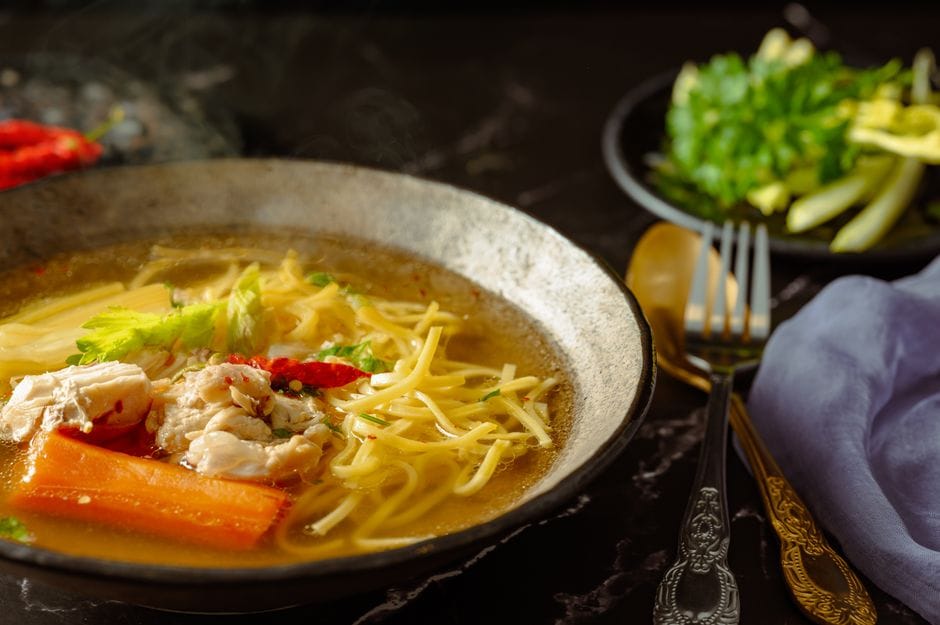
SaveThere is no meta-analysis of chicken soup, so nobody honestly gets to claim it is proven. The same goes for the hot drinks people reach for: lemon tea is soothing rather than medicinal, and its real trade-offs are about teeth and caffeine.
What it does do is uncontroversial: fluid, salt, warmth, and something you can actually face eating when your appetite has gone. When you are unwell and not eating much, those are not small things, and keeping some structure to what you eat matters more than any single remedy.
Eat the soup. Just do not count it as treatment.
Foods To Avoid When Sick: What Earns A Place On That List
Almost as many people search for what to avoid as for what to eat, and the lists they find are longer than the evidence behind them. One item on those lists has actually been tested properly, and it is the one almost everyone believes.
Dairy and mucus. Researchers took 60 volunteers, deliberately infected them with rhinovirus-2, and followed them for ten days. Rather than asking how blocked up people felt, they weighed the tissues: every tissue was collected and sealed immediately after use so nasal secretion could be measured on a scale. That gave 510 person-days of data from 51 people, who drank anywhere from zero to eleven glasses of milk a day 7.
Milk and dairy intake was not associated with congestion, with upper or lower respiratory symptoms, or with the weight of nasal secretion 7. The belief is common — 27.5% of them said they cut dairy during a cold or considered it bad for colds, and 80% of those gave “produces more mucus” as the reason 7.
The most interesting result is what happened to the believers. People who held that view, or who cut milk when ill, reported significantly more cough and congestion — but did not produce more secretion 7. The symptoms were real to them; the phlegm was not there.
A later review reached the same conclusion and added the detail that explains it: a soy-based drink with similar sensory characteristics produced the same perceived changes, so what milk alters is the coating feeling in your mouth and throat, not the mucus in your airways 8. Both reviews note the exception, which is a genuine cow’s milk allergy 8.
So what is actually worth avoiding? On the evidence in this article, the honest list is short. Going above 100 mg of zinc a day, because there is no sign it works better and the side effects are measurable — bad taste and nausea both came out significantly more common than placebo (2)(3). And forcing food down when your appetite has gone, which the review above treats as a normal part of being ill rather than a problem to override (6). Beyond that, keep drinking — water, broth, or whatever you will actually finish — and eat what appeals to you. If nausea is the main problem rather than a cold, that is a different question with a different answer, and it is covered in nausea after eating.
Frequently Asked Questions
What foods should you avoid when sick?
Fewer than the usual lists suggest. The best-known item on them, dairy, has been tested directly: 60 volunteers were infected with rhinovirus-2 and their used tissues were weighed to measure nasal secretion over 510 person-days. Milk and dairy intake was not associated with congestion or with the weight of secretion. People who believed milk makes mucus reported more cough and congestion but did not produce more of it, and a soy drink with a similar mouthfeel caused the same perceived change, so what milk alters is the coating feeling rather than the phlegm. What is worth avoiding, on the evidence here, is zinc above 100 mg a day, which shows no extra benefit and more nausea and bad taste, and forcing food when your appetite has gone.
Does vitamin C help when you already have a cold?
The Cochrane review looked at exactly this and the answer is no. Seven comparisons covering 3,249 cold episodes tested vitamin C started after symptoms appeared, and no consistent effect was seen on either the duration or the severity of colds. Regular daily supplementation is a different question with a different answer: across 31 comparisons it shortened colds by 8% in adults and 14% in children. But it did not reduce how many colds people caught, with a pooled risk ratio of 0.97 in over 10,000 community participants, which is why the authors concluded routine supplementation is not justified.
Do zinc lozenges actually work?
They have the largest effect of anything here, with caveats. A meta-analysis of seven placebo-controlled trials using more than 75 mg of zinc per day found colds were 33% shorter, with a confidence interval of 21% to 45%. A separate meta-analysis of 17 trials covering 2,121 people found colds 1.65 days shorter overall, though statistical heterogeneity was very high at 95%. In that analysis the benefit appeared in adults, at 2.63 days shorter, but there was no significant effect in children. Side effects were more frequent than with placebo, particularly bad taste and nausea.
Is honey good for a cough?
It has better evidence than most cough remedies. A systematic review and meta-analysis included 14 studies and found honey superior to usual care for combined symptom score, cough frequency and cough severity, with low statistical heterogeneity in those comparisons. The picture against placebo specifically was less clear: two studies pooled gave a standardised mean difference of minus 0.63 but with a confidence interval crossing zero and very high heterogeneity. Overall risk of bias across the included studies was moderate, and the authors called for further placebo-controlled trials.
Should I take more zinc for a faster effect?
No, and this has been examined directly. A meta-analysis compared trials using 80 to 92 mg of zinc per day against trials using 192 to 207 mg per day. The lower dose reduced cold duration by 33% and the higher dose by 35%, a difference of two percentage points that was not statistically significant. The authors concluded there is no evidence that zinc doses over 100 mg per day lead to greater efficacy. Given that adverse events including nausea were more common with zinc than placebo, more is simply more side effects.
Does chicken soup do anything?
There is no meta-analysis to cite for it, so anyone claiming a proven effect is going beyond the evidence. What can be said honestly is that it delivers fluid, salt and warmth while you are unwell, and it is easy to eat when appetite is poor. That is a reasonable thing to do and a poor thing to argue about. Where the evidence does exist, it points to zinc lozenges for duration and honey for cough, neither of which stops you having soup.
Does vitamin C ever prevent colds?
In one specific group, yes, and the contrast is striking. Across five trials involving 598 marathon runners, skiers and soldiers on subarctic exercises, vitamin C roughly halved the risk of catching a cold, with a pooled risk ratio of 0.48. In the general community, across 10,708 participants, the risk ratio was 0.97, which is effectively nothing. The review’s interpretation is that vitamin C may be useful for people exposed to brief periods of severe physical exercise, and that routine supplementation for everyone else is not justified.
The Bottom Line
The most popular cold remedy is the one the evidence supports least: vitamin C started when symptoms appear showed no consistent effect across 3,249 cold episodes, and taken daily it did not reduce how often people caught colds at all, with a pooled risk ratio of 0.97 in more than ten thousand participants. It did shorten colds modestly, by 8% in adults, and it halved the risk in marathon runners and soldiers under extreme physical stress. The biggest measured effect belongs to zinc lozenges, 33% shorter colds above 75 mg a day, with no added benefit past 100 mg, no significant effect in children, and a real side-effect burden. Honey beat usual care for cough in 14 studies, though not clearly placebo. Chicken soup has no trial behind it and remains an excellent idea anyway.
This article is for informational purposes only and is not a substitute for professional medical advice. Never give honey to infants under 12 months. Check with a pharmacist or doctor before taking zinc supplements, particularly alongside other medication. Seek medical care for a high fever that persists, breathing difficulty, chest pain, confusion, or symptoms that worsen after initially improving.
Related Articles
Balanced Diet Guide With the 5 Food Groups
High Fiber Foods List and How Much Fiber You Need
Home Remedies for Diarrhea: Rehydration and When to Worry
Low-Glycemic Diet: GI Food List, Benefits and Limits