
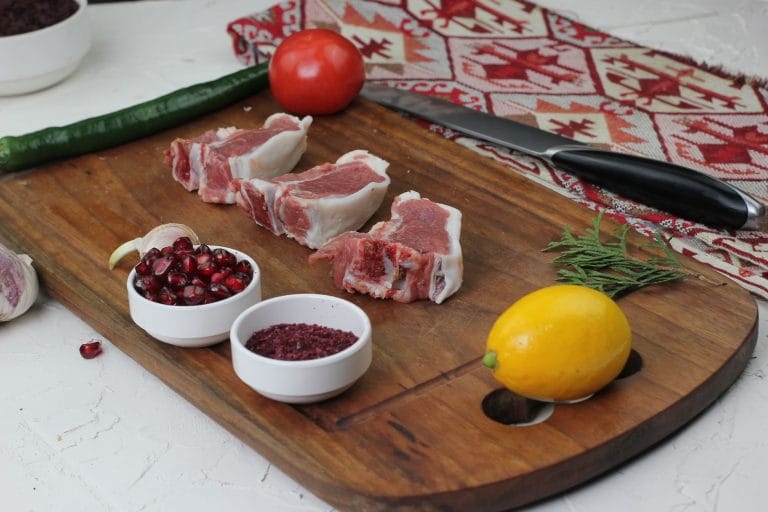
Lamb nutrition by the cut, using USDA’s own figures, plus the red meat risks stated as numbers rather than warnings.
Lamb is the meat of a sheep under a year old. It is a genuinely strong source of three nutrients that are hard to get elsewhere, and it is red meat, with everything that implies.
The previous version of this page got the first part partly wrong and the second part too vaguely. Both are fixed below, and one nutrient it named twice is not really in lamb at all.
Key Takeaways
- Lamb is not a calcium food: about 21 to 26 mg per 100 g, roughly 2% of a day (1, 2).
- Zinc is the standout. Lean braised shoulder gives about 6.4 mg in a 3 oz portion (1, 7).
- Saturated fat ranges from 5.2 g to 10.9 g per 3 oz depending on the cut (1, 2, 9).
- Colorectal cancer risk rises about 14% per 100 g a day of red and processed meat (3).
- Swapping one daily red meat serving for nuts, low-fat dairy or whole grains was linked to 16 to 35% lower type 2 diabetes risk (4).
The Cut Decides Almost Everything
 Save
SaveThe old page gave one set of numbers for “lamb”. That hides the most useful thing you can know about it, which is how far apart the cuts sit. These are USDA figures, converted to a standard 3 oz cooked portion (1, 2).
| Per 3 oz (85 g) cooked | Shoulder, lean only, braised (1) | Shoulder, lean and fat, broiled | Rib, lean and fat, roasted (2) |
|---|---|---|---|
| Energy | 241 kcal | 236 kcal | 305 kcal |
| Protein | 27.9 g | 20.7 g | 17.9 g |
| Total fat | 13.5 g | 16.4 g | 25.3 g |
| Saturated fat | 5.2 g | 6.8 g | 10.9 g |
| Zinc | 6.4 mg | 4.9 mg | 3.0 mg |
| Selenium | 31 µg | 23 µg | 19 µg |
| Vitamin B12 | 2.5 µg | 2.5 µg | 1.9 µg |
| Iron | 2.3 mg | 1.7 mg | 1.4 mg |
| Calcium | 22 mg | 18 mg | 19 mg |
Read the first and last columns against each other. The lean braised shoulder gives you 56% more protein, more than twice the zinc, and half the saturated fat of the fatty rib portion, for 64 fewer calories.
That single choice, made at the counter and again with a knife before cooking, does more for the nutritional profile of a lamb dinner than anything else in this article.
What Lamb Is Genuinely Good At
Three nutrients, and they are worth naming properly because the old page buried them under things that were not true.
Zinc. A 3 oz portion of lean shoulder carries about 6.4 mg. An adult needs roughly 8 to 11 mg a day, so one portion covers well over half of it. Zinc runs immune defence, wound healing and protein synthesis, and it is one of the minerals where plant sources are absorbed less efficiently (7). This is lamb’s strongest single claim and the old page treated it as an afterthought.
Selenium. About 31 µg in that same portion, against a daily requirement of 55 µg. Over half a day, from one serving.
Vitamin B12. About 2.5 µg, which is more than a full day’s requirement, and there is no plant source of it.
Iron is good rather than exceptional: about 2.3 mg per 3 oz of lean shoulder. What makes it useful is that it is haem iron, which the body absorbs far more readily than the non-haem iron in plants (8). If low iron is your reason for eating lamb, that absorbability is real, though liver and shellfish carry considerably more per portion.
And calcium is not on this list. The old page named it twice as one of lamb’s strengths. USDA records 21 to 26 mg per 100 g, about 2% of a day (1, 2). That has been corrected.
The Fat the Old Page Did Not Mention
The previous version noted that lamb “contains monounsaturated fat, the kind associated with lower LDL cholesterol”. That is true as far as it goes, and it goes about half way.
In roasted rib with the fat on, USDA measures 12.8 g of saturated fat against 12.5 g of monounsaturated per 100 g (2). They are essentially equal. Quoting one and not the other is the kind of omission that makes a page less useful than silence.
In practical terms, a 3 oz portion of that rib carries about 10.9 g of saturated fat, close to half the ceiling implied by the Dietary Guidelines’ advice to keep saturated fat under 10% of calories (9). The same portion of lean braised shoulder carries 5.2 g. Trimming is not fussiness; it roughly halves the number that matters.
On grass-fed lamb: its fat profile does include more omega-3 and more conjugated linoleic acid than grain-finished lamb, which is a fair reason to prefer it. The amounts are small in absolute terms, and they do not move lamb out of the red meat category.
The Claims, Checked
| Claim in the previous version | What the sources actually show | Verdict |
|---|---|---|
| Lamb is rich in calcium | USDA records about 21 to 26 mg per 100 g, which is roughly 2% of a day. A glass of milk has five times as much (1, 2) | False |
| Its monounsaturated fat helps lower LDL cholesterol | True of monounsaturated fat in isolation, but the old page never mentioned the saturated fat sitting beside it. In the rib cut they are almost equal: 12.8 g saturated against 12.5 g monounsaturated per 100 g (2) | Misleading by omission |
| CLA in lamb supports fat loss; a trial used 3.2 g a day for six months | That dose is an isolated supplement, and the pooled result was a modest 0.09 kg of fat per week (6). USDA does not list CLA for lamb, and food amounts are nowhere near 3.2 g | Supplement evidence, not a food claim |
| L-carnosine in lamb keeps arteries from stiffening and slows glycation | We could find no completed human trial reporting these outcomes, only a study protocol | Removed |
| Red meat is linked to colon and breast cancer | The colorectal link is well established: +14% per 100 g a day of red and processed meat, rising roughly linearly to about 140 g a day (3). The breast cancer claim is not supported by that source | Half right |
| A 3 oz serving is roughly half an adult’s daily protein | Depends entirely on the cut: 27.9 g for lean braised shoulder, 17.9 g for a fatty rib portion (1, 2) | Only for lean cuts |
About that CLA weight-loss study
This one deserves unpacking, because the old page used a real finding to support something it does not support.
The meta-analysis of 18 randomised, double-blind, placebo-controlled trials found that at the median dose of 3.2 g of CLA a day, people lost fat at about 0.09 kg per week compared with placebo. The authors’ own word for that was “modest” (6).
Two things follow. First, 0.09 kg a week is a small effect even at that dose. Second, and more importantly, 3.2 g a day is an isolated supplement, taken as capsules. USDA does not report CLA content for lamb at all, and the amount in a portion of meat is a small fraction of a gram. You cannot eat your way to a supplement dose, and the section framing lamb as a fat-loss food has been removed.
The Red Meat Risk, in Numbers
 Save
SaveThe old page said red meat is “linked to” heart disease, diabetes and several cancers. That is directionally right and practically useless. Here is what the studies actually measured.
Colorectal cancer. A meta-analysis of prospective studies found the risk for highest versus lowest intake of red and processed meat was 1.22, and that risk rose by 14% for every additional 100 g a day. For fresh red meat specifically, it was 17% per 100 g a day. The dose-response curve rises roughly linearly up to about 140 g a day, then flattens. Notably, the association held for colon cancer but was not significant for rectal cancer (3).
The old page also named breast cancer. That is not supported by this evidence and has been removed.
Type 2 diabetes. Across three large US cohorts totalling over 200,000 people with more than four million person-years of follow-up, each additional daily serving of unprocessed red meat was associated with a hazard ratio of 1.12, and processed red meat with 1.32. The most useful figure in that paper is the substitution analysis: replacing one daily serving of red meat with nuts, low-fat dairy or whole grains was associated with 16 to 35% lower diabetes risk (4).
Cooking matters, and it is measurable. A systematic review of 39 studies quantified the mutagens formed when meat is cooked hot. Intake of PhIP was associated with an odds ratio of 1.20 for colorectal adenoma, with MeIQx at 1.14 and benzo(a)pyrene at 1.10, and a dose-response trend was present (5). In plain terms: the charred crust is not a neutral part of the meal. Cook to done, not to black, and keep flames off the surface.
None of this makes a lamb dinner dangerous. It does mean frequency and portion are the levers, not the nutrient list. A balanced overall pattern absorbs red meat easily a few times a month.
Buying and Cooking It Well
A few things follow directly from the numbers above.
- Choose shoulder, leg or loin over rib when you can, and trim visible fat before cooking rather than after
- Braise, roast or pan-cook to medium rather than charring over direct flame (5)
- Keep the portion around 3 oz cooked, which is a piece about the size of a deck of cards
- Treat it as a few times a month, not a weekly fixture, and vary the protein across the week (4)
- American lamb is generally milder than New Zealand lamb, and rib or loin chops are the gentlest introduction if the flavour is new to you
If you are building protein across the day, lamb sits alongside rather than instead of simpler options like a homemade protein shake, and it fits into a calorie deficit or a carb cycling plan without difficulty at a sensible portion. Pair it with high-fibre foods, which red meat supplies none of.
Frequently Asked Questions
Is lamb actually good for you?
For specific nutrients, yes, and more than most articles give it credit for. A 3 oz portion of lean braised shoulder carries about 6.4 mg of zinc, which is most of a day’s requirement, 31 µg of selenium, 2.5 µg of vitamin B12 and 27.9 g of complete protein. Those are genuinely hard numbers to match elsewhere. The counterweight is that it is red meat, and the frequency of eating it matters more than any single nutrient in it.
How much saturated fat is in lamb?
It depends on the cut more than anything else. Three ounces of lean braised shoulder carries about 5.2 g of saturated fat. The same weight of roasted rib with the fat left on carries about 10.9 g, which is roughly half a day’s ceiling under the Dietary Guidelines. Choosing the cut and trimming it does more than any other decision on this page.
Does lamb contain calcium?
Barely. USDA records about 21 to 26 mg per 100 g, which is around 2% of a day’s requirement. The previous version of this page listed calcium among lamb’s strengths twice, and that was wrong. Lamb’s mineral case rests on zinc, selenium and iron, not calcium.
How often can I eat lamb?
There is no official number for lamb alone, but the red meat research gives you a shape. Colorectal cancer risk rises roughly linearly with intake up to about 140 g a day, and each additional daily serving of unprocessed red meat is associated with about 12% higher type 2 diabetes risk. Nobody is suggesting a Sunday roast is dangerous. A few times a month, in lean cuts and sensible portions, sits comfortably within what the evidence supports.
Is grass-fed lamb better?
It has a somewhat different fat profile, with more omega-3 and more conjugated linoleic acid than grain-finished lamb. The honest caveat is scale: these are small absolute amounts in a food that is mostly saturated and monounsaturated fat. Grass-fed is a reasonable preference. It does not change lamb’s category.
The Bottom Line
Lamb’s real case is zinc, selenium, vitamin B12 and complete protein, and in a lean cut those numbers are excellent. Its real cost is saturated fat that doubles between cuts, and membership of a food category where colorectal cancer risk climbs about 14% per 100 g a day and each daily serving tracks with 12% higher diabetes risk. It is not rich in calcium, and the CLA weight-loss angle belongs to a supplement rather than to dinner. Buy the lean cut, keep the portion to 3 oz, do not burn it, and eat it a few times a month rather than a few times a week.
This article is for informational purposes only and is not a substitute for professional medical advice. Consult a qualified healthcare provider before making significant changes to your diet, especially if you have heart disease, diabetes or a history of cancer.
Related Articles
Balanced Diet Guide With the 5 Food Groups
High Fiber Foods List and How Much Fiber You Need
9 Homemade Protein Shakes Made With Real Food
Carb Cycling Diet Plan: What Studies Show and Sample Week