
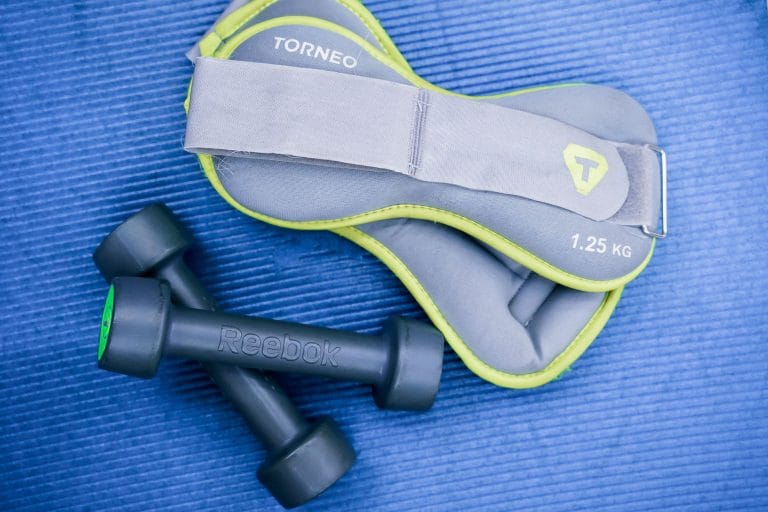
What ankle weight exercises can realistically do, how heavy to start, and the caution this page was missing entirely.
Ankle weights are a genuinely useful, cheap piece of equipment, and they are also routinely oversold. The previous version of this article listed 16 moves with invented set-and-rep numbers and no sources at all, and it never mentioned the question people most often get wrong: whether to wear them while walking or running.
This rewrite keeps the practical part and attaches it to the research that exists, which is thinner than the confidence of most articles on the subject.
Key Takeaways
- Start at roughly 1 to 2% of body weight; that is already enough to change how you move (5).
- Do not run in them. Running with a leg weight increased knee range-of-motion asymmetry (4).
- The best evidence is in older adults, and it is preliminary (2).
- Elastic bands outperformed weights for movement speed in one trial (6).
- The target to aim at is strengthening all major muscle groups on 2+ days a week (1).
What They Can and Cannot Do
 Save
Save| Question | What the research actually shows | Verdict |
|---|---|---|
| Do they build lower-body strength? | The most relevant study invited 74 community-dwelling adults aged 50 to 90 to use ankle weights for 3 months. Performance on the 30-second chair stand test improved, and the authors concluded that wearing ankle weights can be recommended for strengthening lower limb and trunk muscles in older adults. It was a preliminary report with no control group (2) | Promising, in older adults |
| Do they make walking harder? | Yes, modestly. Walking on a treadmill with 1.36 kg ankle weights raised oxygen uptake and heart rate compared with no weights, but by less than the same weight held in the hands or on the wrists (3) | Small real effect |
| Should I run in them? | In a study of walking and running with a weight on one leg, running with the weight increased asymmetry in knee range of motion. Whatever the long-term significance, you are changing how the joint moves (4) | Not for running |
| Is heavier better? | Loads of 1% and 2% of body weight produced measurable changes in walking distance, speed and cadence, so small loads are already doing something (5) | Start very light |
| Are they the best tool for power? | Not necessarily. In mobility-impaired older women, 12 weeks of training with elastic bands improved foot movement time by 12%, while the weights group did not show that improvement, though strength rose in every group (6) | Bands may beat them |
| Do they replace strength training? | No. The guideline target is muscle-strengthening activity on 2 or more days a week working all the major muscle groups; ankle weights can be one way to do that, not a substitute for it (1) | One tool among many |
The strongest finding
The most directly relevant study is worth describing properly, because it is both the best support ankle weights have and a reminder of how limited that support is.
Seventy-four community-dwelling adults aged 50 to 90 were invited to use ankle weights for three months. Their performance on the 30-second chair stand test improved, a measure that reflects lower limb and trunk strength and is used as an indicator of fall risk. The authors concluded that wearing ankle weights can be recommended for strengthening the muscles of the lower limb and trunk in older adults (2).
It was published as a preliminary report and had no control group, so some of the improvement may simply reflect doing more exercise than before. That is still a reasonable reason to own a pair.
The Caution That Was Missing
This is the main thing the previous version should have said and did not.
Ankle weights are frequently worn during walks and runs, on the theory that a little extra load burns a little extra energy. It does: walking on a treadmill with 1.36 kg ankle weights raised oxygen uptake and heart rate compared with walking unweighted. But the same weight in the hands or on the wrists raised them more, and hand weights also raised diastolic blood pressure (3).
Running is a different matter. When people ran with a weight on one leg, asymmetry in knee range of motion increased compared with running normally (4). A weight at the ankle sits at the far end of the lever formed by your shin, so it acts on the knee and hip with more leverage than the same weight closer to your body, and it does that thousands of times per run.
The sensible use is what the research studied: deliberate, controlled strength sets, not wearing them through cardio. If you want walking to be harder, walk faster or find a hill.
How Much Weight
Much less than the “1 to 10 pounds” range suggests as a starting point.
In one study of healthy adults, loads of 1% and 2% of body weight produced significant differences in walking distance, speed and cadence compared with no load (5). For a 70 kg person that is 0.7 to 1.4 kg per ankle. If that small a load measurably changes your gait, it is doing plenty in a strength set.
The rule that matters more than any number: the weight is right when you can control the movement through its full range and stop it rather than let it drop. When it starts swinging you, it is too heavy.
Putting Them On
- Check the strap first. Frayed velcro or a cracked buckle means it is finished. A weight coming loose mid-swing is how ankles get hurt.
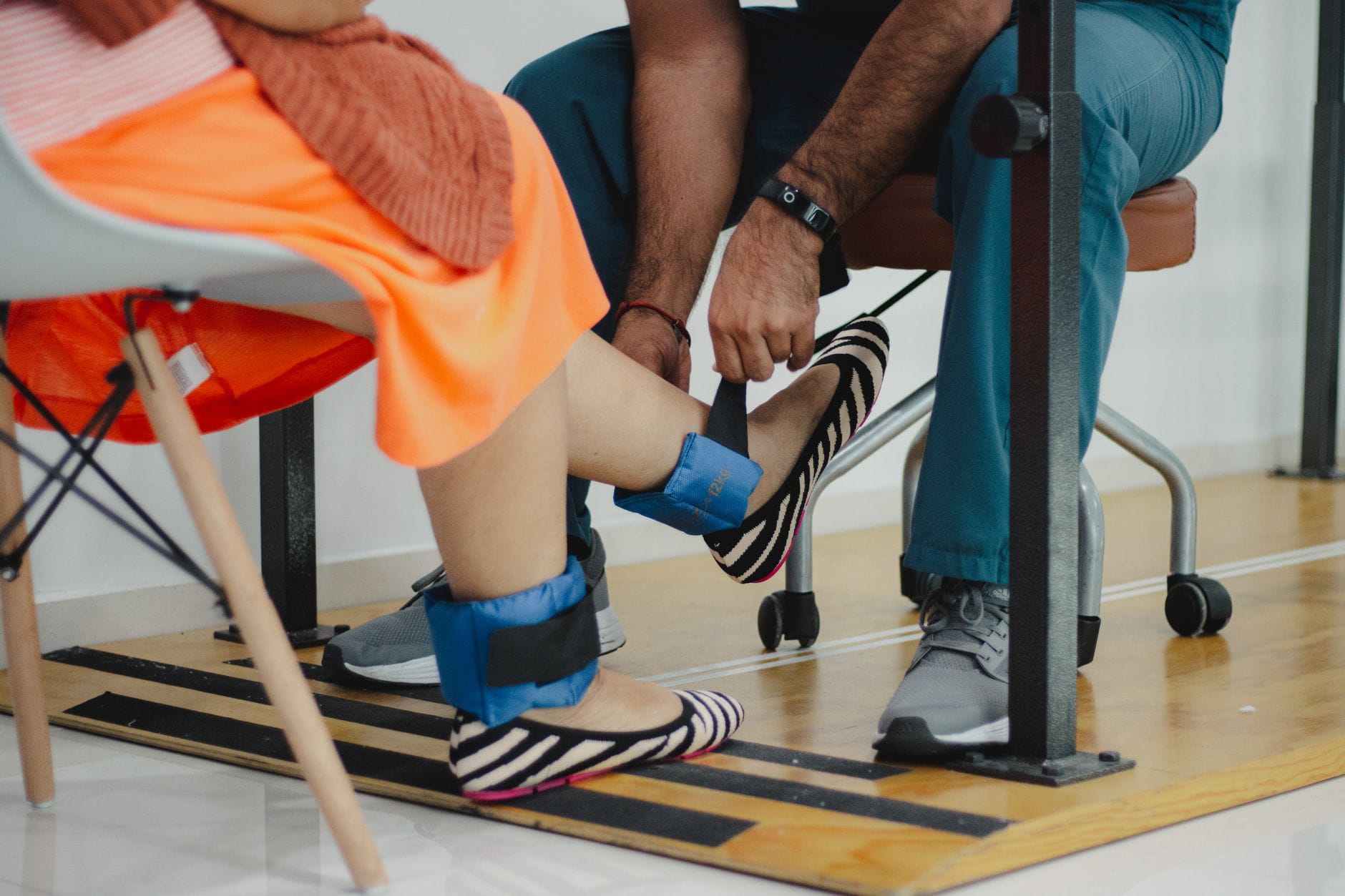
- Snug, not tight. It should not pinch or leave a mark, and your foot should not tingle.
- Wear both. The gait research that found increased asymmetry used a weight on one leg (4). Match them.
- They fit wrists too, which is a legitimate way to add a little load to arm and shoulder work (3).
Moves Worth Doing
 Save
SaveThese are the ones where a small ankle load makes sense, because the leg is moving through space and the weight adds resistance without changing the shape of the movement.
- Standing side leg raise. Stand tall, lift one leg out to the side under control, lower it slowly without letting it swing back.
- Side-lying leg raise. On your side, lift the top leg, pause, lower it almost to the other leg, repeat.
- Donkey kick. On all fours, press one heel back and up, stopping short of arching your lower back.
- Hamstring curl. On all fours or standing, bend the knee to bring the heel towards your hip, lower slowly.
- Lying leg raise and leg drop. On your back, lower one straight leg towards the floor and lift it again, keeping your lower back flat on the mat.
- Seated flutter or leg extension. Sitting, straighten and lower each leg in turn.
We have not reproduced the previous version’s precise set-and-rep prescriptions, because they were invented. The guideline target is muscle-strengthening activity involving all the major muscle groups on 2 or more days a week (1). Within that, work to the point where the last repetition is hard but still controlled, and give the muscle a day off before repeating.
We have also dropped the weighted hamstring stretch. Loading a stretch at the end of range is not a beginner instruction, and it was not something any source supported.
On the core moves
Ankle weights do make crunches, sit-ups and leg drops harder, because your legs are heavier. They also increase the pull on your lower back during leg lowering, which is where most people lose the flat-back position. If your lower back lifts off the mat, the weight is too heavy or the leg is going too low.
Who Should Be Careful
- Ongoing knee or hip pain. Knee problems are common and have many causes, and adding leverage at the ankle is the wrong direction while something hurts (9).
- After surgery on the knee or hip. Your surgeon or physiotherapist decides when load goes back on, not an article.
- Balance problems. Standing single-leg work with added weight is a fall risk before it is a strength exercise (8).
- New to exercise. Get the movement right without weight first (7).
Ankle weights are one way to meet the strengthening part of the guidelines, alongside bands, bodyweight work and dumbbells. Our home workout guide covers the wider routine, the dumbbell plan covers the loaded version, and the calorie deficit guide covers the eating side if fat loss is the goal.
Frequently Asked Questions
How heavy should ankle weights be to start?
Lighter than most people expect. In one study, loads of just 1% and 2% of body weight already changed walking distance, speed and cadence measurably. For a 70 kg person that is 0.7 to 1.4 kg. Start at the bottom of the range, keep the movement controlled, and add weight only when it stays that way.
Should I wear ankle weights while walking or running?
Not for running. When people ran with a weight on one leg, asymmetry in knee range of motion increased. For walking, ankle weights do add a small amount of work, but less than the same weight in your hands, and the load sits at the end of a long lever at your knee and hip. Use them for deliberate strength sets rather than wearing them through cardio.
Do ankle weights actually work?
For lower-body and trunk strength in older adults there is encouraging early evidence: 74 community-dwelling adults who used them for three months improved on the 30-second chair stand test. That study had no control group, so treat it as promising rather than proven. There is no good trial showing ankle weights tone or slim any particular body part.
Who should avoid them?
Anyone with ongoing knee or hip pain, anyone recovering from surgery on those joints, and anyone whose clinician has advised against extra joint load. Adding weight at the ankle multiplies the leverage acting on the knee, which is the opposite of what an irritated knee needs.
Can I wear them on my wrists instead?
Yes, the straps fit, and in the treadmill study wrist weights raised oxygen uptake and heart rate slightly more than ankle weights did. That study also found hand-held weights raised diastolic blood pressure, which is worth knowing if blood pressure is a concern for you.
The Bottom Line
Ankle weights are a cheap, portable way to add resistance to leg movements, and the clearest evidence for them is in older adults, where three months of use improved chair-stand performance in a preliminary study without a control group. Start around 1 to 2% of body weight, which is already enough to change how you walk. Wear both, not one. Use them for controlled strength sets rather than wearing them through a run, because running with a leg weight increased knee asymmetry, and a weight at the ankle acts on the knee with a long lever. They are one way to hit the two-days-a-week strengthening target, not a shortcut past it.
This article is for informational purposes only and is not a substitute for professional medical advice. Talk to a doctor or physiotherapist before using ankle weights if you have knee or hip pain, have had surgery on those joints, or have problems with balance.
Related Articles
Workouts for a Lean and Fit Body: 15 Moves, No Gym Needed
Dumbbell Workout Plan for Women: 9 Moves and Weekly Plan
Swimming for Weight Loss: What Trials Found
Calorie Deficit Diet Guide for Safe Weight Loss