
Fifteen workouts for a lean and fit body you can do at home. Includes starting sets, a sample week, and what research says about fat loss.
Most home workout lists promise a lean body and skip the boring part: how much training is actually needed. They also skip what exercise can and cannot do on its own. These workouts for a lean and fit body cover both. Every move here works in a small space, and most need nothing but a mat.
Health authorities set the target clearly. Adults need 150 to 300 minutes of moderate aerobic activity a week, or 75 to 150 minutes of vigorous activity. Muscle-strengthening work is recommended on 2 or more days (1). Nearly 80% of adults do not meet both parts (2). The World Health Organization stresses that any amount of activity is better than none (3).
Key Takeaways
- Aim for 150 to 300 minutes of moderate activity a week. Add strength work on 2 or more days (1).
- Progressive bodyweight training builds real strength: push-up training matched bench-press training for strength gains in one trial (5).
- Interval training and steady cardio both reduce body fat, with only a small difference between them (4).
- Core exercises alone do not reduce belly fat, though the evidence is not unanimous (6, 7).
- Training combined with a moderate calorie deficit beats training alone for fat loss (10).
How Much Exercise You Actually Need
The weekly total matters more than any single session. Current recommendations are 150 to 300 minutes a week of moderate-intensity aerobic activity, 75 to 150 minutes of vigorous activity, or a mix of both. Muscle-strengthening activities should cover the major muscle groups on at least 2 days (1). Going beyond 300 minutes brings additional health benefits (2).
One practical update: a session no longer has to last 10 minutes to count. Short bouts count toward your weekly total (1). Ten focused minutes on a busy day is not wasted.
Cardio Moves That Raise Your Heart Rate
 Save
SaveRunning is the simplest option, indoors or out. Start with a brisk walk or slow jog, then alternate faster and easier stretches once you are warm. If you prefer the water, swimming works the whole body with almost no impact.
Indoors, four moves cover the same ground: rope jumps, jumping jacks, high knees, and burpees. Intervals are time-efficient, but they are not magic. In a meta-analysis of 29 randomized trials, interval training and moderate continuous training both improved body composition and fitness. The difference between them was small (4).
Lower-Body Moves
Your legs and glutes hold the largest muscles in the body, so they are worth training properly. Bodyweight squats come first: sit back as if to a chair, keep your heels down, and stand up under control. Reverse lunges are gentler on the knees than forward lunges because you step backwards into the position.
Hip thrusts need only a sofa. Rest your upper back on the edge and plant your feet. Drive your hips up until your body forms a straight line from knees to shoulders. Jump squats add power, but they are high-impact and optional.
Core Moves
 Save
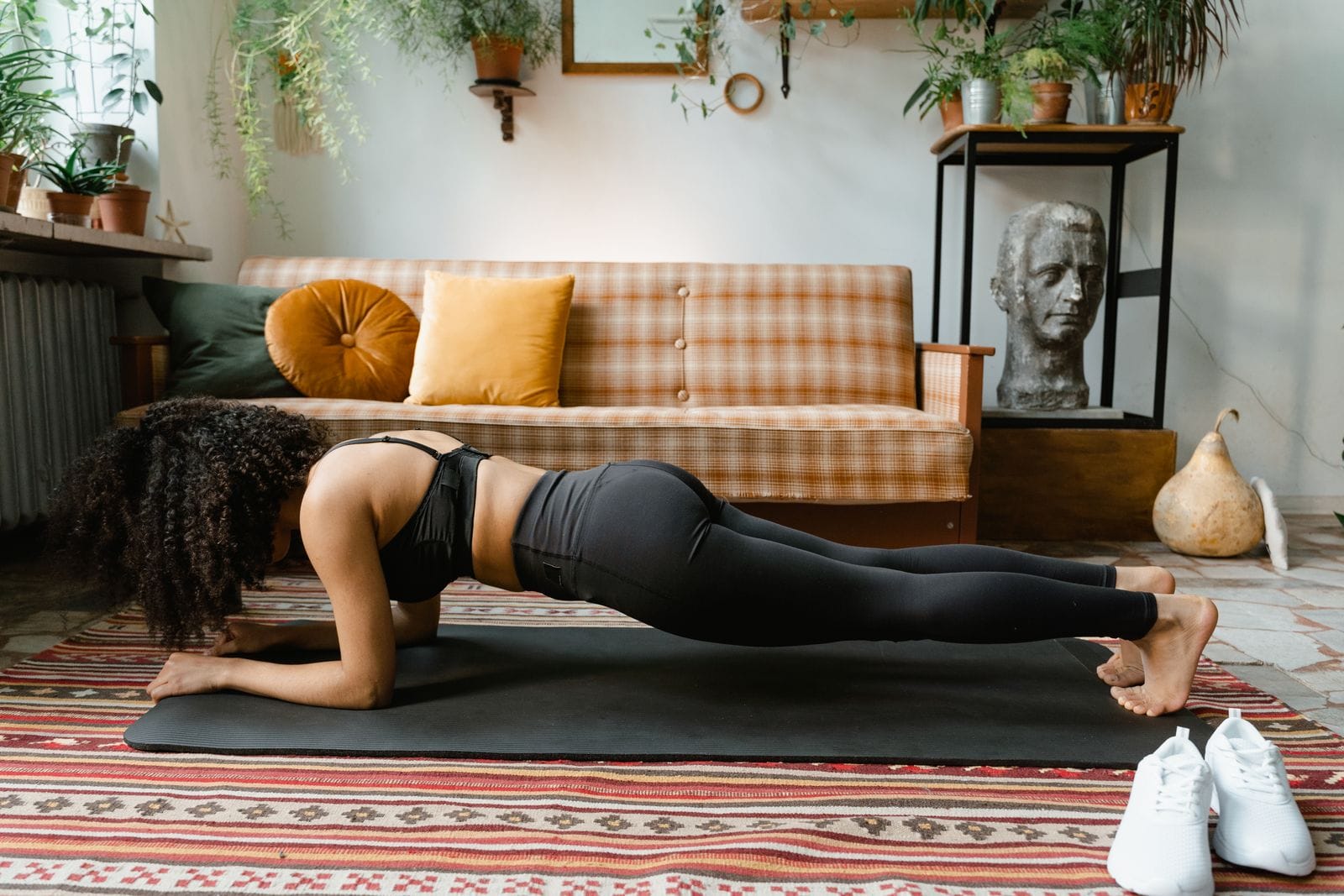
SaveHere is the part most articles get wrong. Core training builds strength and stability, but it does not melt belly fat. In a controlled trial, 6 weeks of abdominal exercises 5 days a week improved abdominal endurance. It produced no change in abdominal fat, body fat percentage, or waist measurements (6).
To be fair to the other side, a 2023 trial matched energy expenditure between groups. It found more trunk fat loss when abdominal endurance work was added, so researchers still disagree (7). Either way, train your core for strength. Handle fat loss through overall activity and diet.
Start with forearm planks, dead bugs, flutter kicks, and Russian twists. If your lower back aches during a move, stop and switch to dead bugs, which keep the spine supported.
Upper-Body Moves
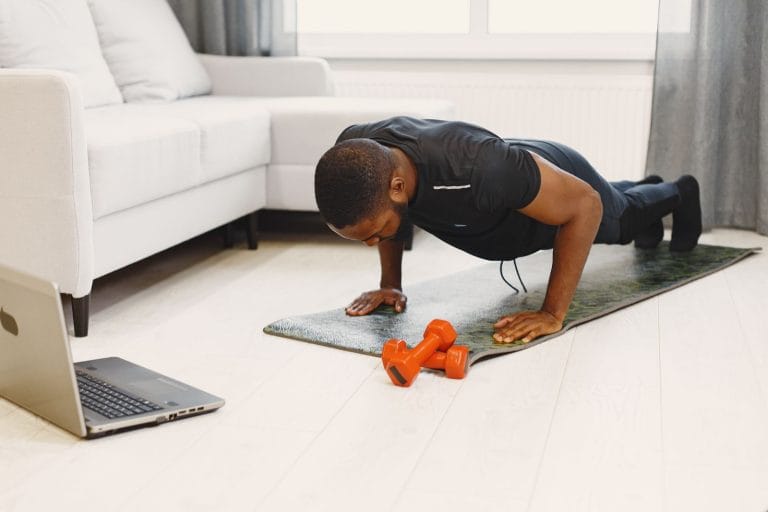
Push-ups are the anchor, and they scale to any level: wall, incline on a table, knees, then full. Progression is what makes them work. In a 4-week randomized study, progressive calisthenic push-up training increased bench-press strength as much as actual bench-press training (5). If you own dumbbells, our dumbbell workout plan adds pressing and rowing variations.
Workouts for a Lean and Fit Body: The 15 Moves
Sets and reps below are starting points for a healthy beginner, not prescriptions. Add reps or slow the tempo before adding difficulty:
| Move | Where to start | What it trains |
|---|---|---|
| Rope jumps | 3 rounds of 30 to 60 seconds | Whole-body cardio, calves |
| Jumping jacks | 3 sets of 30 | Cardio, shoulders, legs |
| High knees | 3 rounds of 30 seconds | Cardio, hip flexors |
| Burpees | 3 sets of 6 to 10 | Cardio plus legs, chest, core |
| Running or brisk walking | 20 to 30 minutes | Aerobic fitness |
| Bodyweight squats | 3 sets of 12 to 15 | Quads, glutes |
| Jump squats | 2 sets of 8 to 12 | Power, glutes, quads |
| Reverse lunges | 3 sets of 10 per leg | Glutes, quads, balance |
| Wide (plie) squats | 3 sets of 12 | Inner thighs, glutes |
| Hip thrusts on a sofa | 3 sets of 12 | Glutes, hamstrings |
| Forearm plank | 3 holds of 20 to 45 seconds | Deep core, shoulders |
| Dead bugs | 3 sets of 8 per side | Core control, low-back friendly |
| Flutter kicks | 3 sets of 20 seconds | Lower abdominals |
| Russian twists | 3 sets of 20 total | Obliques |
| Push-ups (wall, knee or full) | 3 sets of 5 to 12 | Chest, shoulders, triceps |
A Sample Week
This layout reaches roughly 170 minutes of activity, which covers the aerobic target and both strength days (1):
| Day | Session | Roughly |
|---|---|---|
| Monday | Lower body plus core | 30 minutes |
| Tuesday | Cardio: brisk walk, run, or rope | 30 minutes |
| Wednesday | Rest or easy walk | 20 minutes |
| Thursday | Upper body plus core | 30 minutes |
| Friday | Intervals: jacks, high knees, burpees | 20 minutes |
| Saturday | Longer easy cardio | 40 minutes |
| Sunday | Rest | – |
What Training Can and Cannot Do for Fat Loss
| Common claim | What the research shows | Verdict |
|---|---|---|
| “Intervals burn far more fat than steady cardio” | A meta-analysis of 29 randomized trials found interval training and moderate continuous training both improved body composition, with interval training slightly better for waist circumference and body fat percentage, though the authors called the clinical difference limited (4) | Both work; pick what you will keep doing |
| “Ab exercises flatten your stomach” | In a controlled trial, 6 weeks of abdominal exercises 5 days a week improved muscular endurance but did not reduce abdominal fat or body fat percentage (6). A later trial that matched energy expenditure reported more trunk fat loss with abdominal endurance work, so the question is not fully settled (7) | Train your core for strength, not to spot-reduce |
| “Bodyweight moves are too easy to build strength” | In a 4-week randomized study, progressive push-up training raised bench-press strength as much as bench-press training did (5) | Progression matters more than equipment |
| “A hard session keeps burning calories all day” | The afterburn effect depends on how hard and how long you train; after low-intensity or short sessions it is minimal (8) | Real, but small for most home workouts |
| “Exercise alone is enough to lose weight” | A systematic review concluded the most effective approach combines strength plus endurance exercise of at least 175 minutes a week with an individualized reduced-calorie diet (10) | Training plus diet beats training alone |
Two more numbers are worth knowing. The “afterburn” is the extra oxygen your body uses while recovering. It rises with how hard and how long you train, and is minimal after easy or short sessions (8). If you are dieting while training, keep the deficit moderate. A meta-analysis found that deficits above about 500 calories a day held back muscle gains from resistance training (9). Our guide to a sensible calorie deficit explains how to set that. The cutting diet guide covers keeping muscle while losing fat.
Form, Safety and Who Should Check First
- Warm up for 5 minutes and build volume gradually rather than jumping into maximum sets.
- High-impact jumping is optional. Step-backs, walking lunges and squats without the jump train the same muscles.
- If you have high blood pressure, dynamic resistance training is considered safe when the load is not too heavy. Check with your doctor first (1).
- For osteoarthritis, exercise is now strongly recommended rather than avoided, because it reduces pain and improves function (1).
- Pregnancy, recent injury or heart conditions all warrant medical advice before starting.
- Muscle cramps during or after training are common; our guide to charley horse relief covers what helps.
If your goal is size rather than leanness, the principles change, and our bodybuilding diet guide covers the nutrition side.
Frequently Asked Questions
How many days a week should I work out?
Guidelines for adults are 150 to 300 minutes a week of moderate aerobic activity, or 75 to 150 minutes of vigorous activity. Muscle-strengthening work is recommended on 2 or more days. Spread across a week, that usually means 3 to 5 sessions. Any activity counts, and short bouts count too.
Can I get lean without a gym?
Yes, if you make the moves progressively harder. In one randomized study, 4 weeks of progressive push-up training improved bench-press strength as much as bench-press training. Add reps, slow the tempo, or use harder variations as you get stronger.
Will crunches give me a flat stomach?
Not on their own. In a controlled trial, 6 weeks of abdominal exercises improved endurance but did not reduce abdominal fat. Core training builds strength and stability, while fat loss depends mostly on overall energy balance.
How long before I see results?
Strength usually improves within a few weeks. Visible body composition changes take longer and depend on diet as well as training. Research on weight management points to combining regular training with a moderate calorie deficit. Exercise alone rarely does the work.
Are jumping exercises safe for everyone?
No. High-impact moves are not suitable for everyone with joint pain. People with high blood pressure or a pregnancy should get medical advice first. Low-impact versions, such as step-backs instead of jumps, give similar training benefits with less stress on the joints.
The Bottom Line
Workouts for a lean and fit body do not require a gym. They require a weekly total: 150 to 300 minutes of aerobic activity plus two strength sessions. Build it from moves you can progress over time. Intervals and steady cardio both work. Push-ups and squats build real strength when they get harder, and core work is for strength rather than spot reduction. Pair the training with a moderate calorie deficit and give it months, not days.
This article is for informational purposes only and is not a substitute for professional medical advice. Talk to your doctor before starting a new exercise program. This is especially important if you have joint problems, high blood pressure, a heart condition or are pregnant.
Related Articles
How to Burn 2000 Calories a Day, and Why a Week Works Better
Dumbbell Workout Plan for Women: 9 Moves and Weekly Plan
Calorie Deficit Diet Guide for Safe Weight Loss
Charley Horse Relief: Fast Fixes and What Research Shows
Blood Pressure After Exercise: What the Data Shows
Natural Muscle Relaxers: What the Evidence Shows
Tree Pose Benefits: What Actually Holds Up
L-Glutamine: What the Evidence Actually Supports
Ankle Weight Exercises: What Works, and Limits