
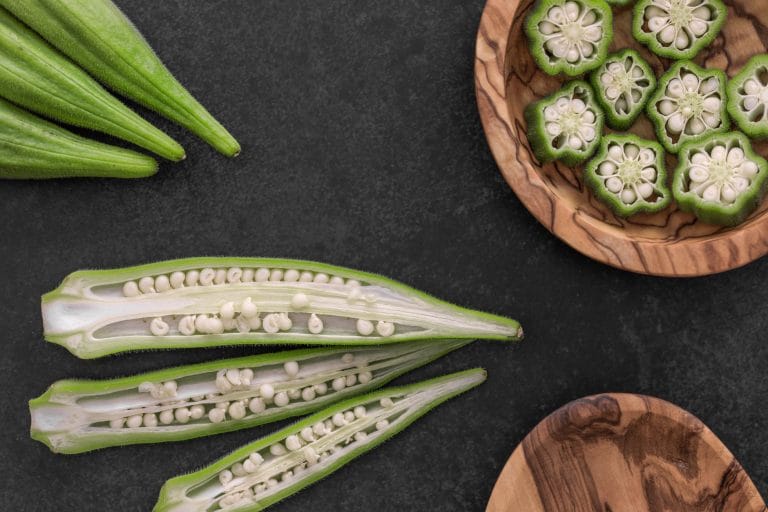
What okra water is, what the human trials on okra actually found, and the medication question this page never asked.
Okra water is made by soaking or blending okra pods in water and drinking the infusion. The appeal is obvious: the nutrients without the texture.
This page has been rewritten for two reasons. The previous version rested largely on rat and test-tube studies presented as human benefits, with several sources from aggregator sites we could not verify. And it never mentioned the one thing a person taking okra for blood sugar most needs to know, which is that okra and metformin may not belong in the same stomach at the same time.
Key Takeaways
- Okra does lower blood glucose in trials: FBG −21.7 mg/dL, HbA1c −0.42% (1).
- Every one of those trials used okra powder or extract, not okra water (1, 2, 3).
- In rats, okra reduced metformin’s effect. Ask your doctor first (5).
- No significant effect on insulin resistance, BMI or body weight (1).
- Okra is not a good iron source: 0.62 mg per 100 g (6).
What Is Actually in It
 Save
SaveOkra (Abelmoschus esculentus) is a cheap, useful vegetable. The slippery coating is mucilage, a soluble fibre, and that is what gives the water its texture.
Here is the honest starting point, which the previous version buried: the nutrient content of okra water itself has not been measured. Every figure you see quoted for it is carried over from the whole pod and assumed to dissolve. So the table below is what is in the vegetable, not what is in your glass.
| Per 100 g raw okra | Amount | Note |
|---|---|---|
| Energy | 33 kcal | Mostly water, 89.6 g |
| Fibre | 3.2 g | The mucilage is part of this |
| Vitamin C | 23 mg | Acts as an antioxidant (9) |
| Magnesium | 57 mg | A genuine strength |
| Calcium | 82 mg | Reasonable for a vegetable |
| Potassium | 299 mg | |
| Folate | 60 mcg | |
| Protein | 1.93 g | Low. This is not a protein food |
| Iron | 0.62 mg | Low, despite okra’s reputation |
Two corrections there. The previous version described okra as delivering protein and iron. At 1.93 g of protein and 0.62 mg of iron per 100 g, it does neither in any meaningful way (6). Where it is genuinely good is magnesium, vitamin C, folate and fibre.
Blood Sugar: The Real Evidence
This is the part worth taking seriously, and it has improved a lot since this page was first written. There are now human randomised trials, so we no longer have to reason from rats.
A 2025 systematic review and meta-analysis pooled six randomised controlled trials of okra supplementation in people with type 2 diabetes. Okra significantly reduced fasting blood glucose, by a weighted mean difference of 21.72 mg/dL, and HbA1c, by 0.42%. It did not significantly change insulin levels, insulin resistance measured by HOMA-IR, BMI or body weight (1).
Two of the individual trials give a sense of what that looked like:
- 100 patients, three months. One gram of powdered okra fruit three times a day, alongside standard therapy of metformin and gliclazide, produced significant falls in fasting glucose, HbA1c, total cholesterol and triglycerides compared with placebo, with lower hs-CRP and no adverse effects on liver, kidney or blood pressure (2).
- 60 patients, eight weeks. Ten grams of okra powder blended into yogurt twice a day lowered fasting plasma glucose, insulin resistance, triglycerides, total cholesterol and LDL. HbA1c and body measurements did not change (3).
And one that found nothing, which matters just as much. In a triple-blind trial in 64 patients with diabetic nephropathy, 125 mg of dried okra extract daily for 10 weeks produced no significant between-group difference in kidney function, glycaemic control, inflammation or gene expression. The authors concluded that okra extract did not have impressive effects in that group (4).
The gap between okra and okra water
Notice what every one of those trials used: powdered pod in capsules, powder blended into yogurt, or a standardised extract, at a measured daily dose.
None of them soaked pods in water overnight. Nobody has measured how much of okra’s active material ends up in the infusion, so there is no way to say whether a glass of okra water delivers 10% of a trial dose or 1%. The evidence supports okra. Whether it supports okra water is an open question, and honest pages should say so.
The Medication Question
This is the section that was missing, and it is the reason to talk to a doctor before making okra water a daily habit.
In a study in rats, the water-soluble fraction of okra significantly reduced the absorption of oral glucose, and also interfered with metformin. Diabetic rats given metformin together with okra had average blood glucose of 33.6 to 34.2 mmol/L over the following hours, against 15.2 to 20.2 mmol/L with metformin alone. The authors’ conclusion was direct: okra may improve glycaemic control, but it should not be taken concurrently with metformin hydrochloride (5).
That is animal data, and it has not been confirmed in people. But note who is reading this page: mostly people with raised blood sugar, and metformin is the most commonly prescribed first-line drug for type 2 diabetes. A plausible mechanism for blunting your medication is worth a conversation with whoever prescribed it, especially since the clinical trial that worked gave okra as an adjunct under supervision (2).
More generally, NCCIH’s review of dietary supplements for diabetes is a useful corrective to how these things get marketed, and NIDDK’s guidance on eating with diabetes remains the foundation (7, 8).
What We Removed
| Claim | What the human evidence shows | Verdict |
|---|---|---|
| Lowers blood sugar | A 2025 meta-analysis of 6 randomised trials in type 2 diabetes found okra supplementation reduced fasting blood glucose by 21.7 mg/dL and HbA1c by 0.42%, both statistically significant (1) | Supported, for okra |
| Improves insulin resistance or helps weight loss | The same meta-analysis found no significant effect on insulin, HOMA-IR, BMI or body weight (1) | Not supported |
| Helps cholesterol | Two randomised trials in type 2 diabetes reported lower total cholesterol and triglycerides than control (2, 3) | Reasonable |
| Helps diabetic kidney disease | A triple-blind trial in 64 patients with diabetic nephropathy found no significant between-group difference in kidney function, glycaemic control, inflammation or gene expression (4) | Not shown |
| Boosts immunity and fights bacteria | The studies behind this were in mice and in test tubes. We have removed the claim rather than present animal findings as human benefits | Claim removed |
| Slows skin ageing and protects against sun damage | No trial evidence. Removed | Claim removed |
The immunity and antibacterial sections came from mouse experiments and bacterial cultures. The skin and anti-ageing paragraph had no trial behind it at all; okra does contain vitamin C, which acts as an antioxidant (9), but that is a long way from softening wrinkles.
We also removed a quoted description attributed to a chef, because we could not verify it, and several references that pointed to aggregator sites rather than to the studies themselves.
If You Want to Drink It
Slice four or five pods, leave them in a glass of water overnight, strain and drink. It is cheap, hydrating and harmless for most people.
- Treat it as a vegetable drink, not a treatment.
- Go easy at first. Fibre and mucilage can cause bloating, gas or loose stools.
- Skip it entirely if you are allergic to okra.
- Ask first if you take glucose-lowering medication (5).
- Eating the pods is not worse. The trials used the whole pod, so if you can tolerate cooked okra, that is closer to what was tested.
For the wider picture, our blood sugar guide covers what has been tested properly, the insulin resistance guide covers the pattern that works, and the fibre guide covers the part okra genuinely does well.
Frequently Asked Questions
Does okra water actually lower blood sugar?
Okra does, in trials. A 2025 meta-analysis of six randomised trials in type 2 diabetes found fasting glucose down about 21.7 mg/dL and HbA1c down 0.42%. But every one of those trials used okra powder, capsules or extract at measured doses. Nobody has run the same trial on water that pods were soaked in, so the amount you get is unknown.
Can I drink it if I take metformin?
Ask your doctor first, and this is the most important line on the page. In a rat study, the water-soluble fraction of okra markedly reduced metformin’s effect on blood glucose, and the authors concluded that okra should not be taken at the same time as metformin. That is animal data, but the direction of the risk is the opposite of what people take okra water for.
How much okra did the trials use?
More than a glass of soaking water is likely to contain. One trial gave 1000 mg of powdered okra three times a day for three months; another gave 10 g of okra powder blended into yogurt twice a day for eight weeks. Those are whole-pod doses, not an infusion.
Is okra water high in iron?
No, and this is a correction. Raw okra has 0.62 mg of iron per 100 g, which is low. Its better numbers are magnesium at 57 mg, calcium at 82 mg and vitamin C at 23 mg per 100 g, and even those are for the pod rather than the water.
Are there side effects?
The fibre and mucilage can cause bloating, gas or loose stools in some people. Anyone allergic to okra should avoid it. And if you take medication for diabetes, the interaction question above comes before any of this.
The Bottom Line
Okra has better evidence behind it than most vegetables promoted for blood sugar: a 2025 meta-analysis of six randomised trials found fasting glucose down about 21.7 mg/dL and HbA1c down 0.42% in type 2 diabetes. What it does not show is any effect on insulin resistance, BMI or weight, and one trial in diabetic kidney disease found nothing at all. The catch specific to this page is that every trial used okra powder or extract at a measured dose, while okra water is an infusion of unknown strength. And because a rat study found okra blunted metformin badly enough that the authors said not to take them together, anyone on diabetes medication should ask their doctor before making this a daily habit.
This article is for informational purposes only and is not a substitute for professional medical advice. Talk to your doctor before using okra or okra water regularly if you have diabetes or take any glucose-lowering medication, and never stop or adjust prescribed medicine on your own.
Related Articles
How to Lower Blood Sugar Naturally: 8 Evidence-Based Habits
Insulin Resistance Diet: What the Evidence Backs
High Fiber Foods List and How Much Fiber You Need
Diabetes Diet: Plate Method, Carbs and the Evidence