

What tree pose actually does, which of its advertised benefits hold up, and how to stand in it without hurting a knee.
Vrikshasana takes its name from vriksha, tree, and asana, posture. One leg roots down, the arms rise, and the whole thing lives or dies on a steady gaze. It is usually one of the first balancing poses people learn.
The tree pose benefits you will see listed online run long, and most of that list has nothing behind it. We have rewritten this article to separate what is supported, mainly balance, from the claims about sciatica, flat feet and circulation that were here before without a single source.
Key Takeaways
- Balance is the benefit with real support; yoga counts as a balance activity in physical activity guidelines (3, 5).
- Standing balance exercise improves clinical balance measures in older people (3).
- The lifted foot goes above or below the knee, never against the joint.
- NCCIH lists knee or hip injury, lumbar spine disease, severe hypertension, balance problems and glaucoma as reasons to modify (1).
- Yoga injuries seen in emergency departments are more common in people over 65 (1).
How to Do It
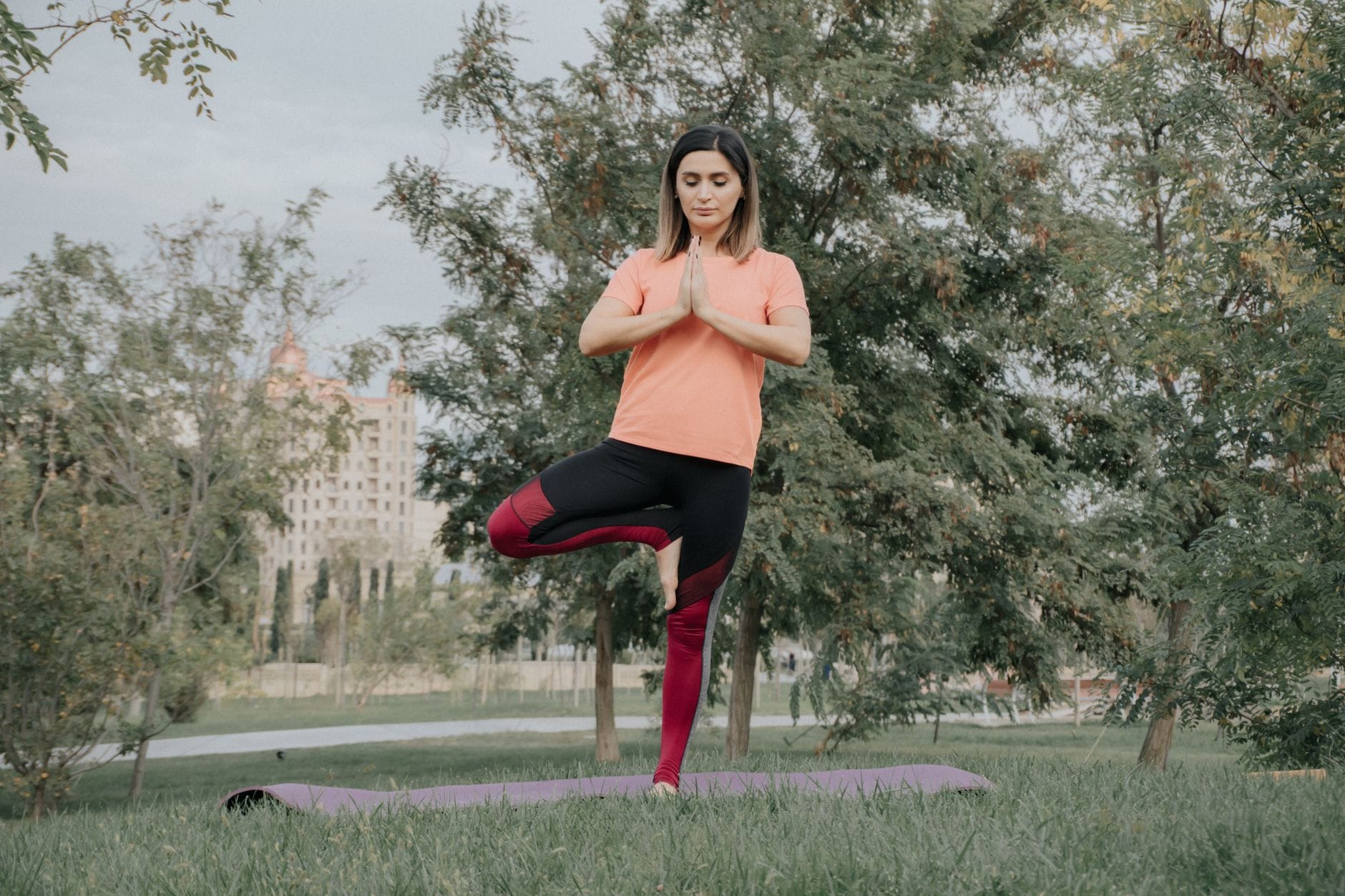 Save
Save- Stand tall, feet together, arms relaxed at your sides.
- Shift your weight onto the left foot and feel the whole sole make contact.
- Bend the right knee and place the sole of the right foot on the inner left thigh above the knee, or on the calf below it. Never on the side of the knee.
- Keep the standing leg straight but not locked. Find your balance before going further.
- Bring the palms together at the chest, then raise the arms overhead if that feels stable.
- Fix your gaze on one unmoving point. A steady gaze is what keeps you steady.
- Breathe evenly. Hold 20 to 30 seconds to start, then lower the arms, release the foot and repeat on the other side.
Unlike many postures, this one is practised with the eyes open, because vision is one of the three systems the body uses to balance, alongside the inner ear and sensation from the feet and joints.
The common mistakes
- Foot on the knee. The knee is a hinge, not a shelf; side pressure is what causes trouble.
- Hip swinging out. Keep the pelvis level rather than letting the standing hip push sideways.
- Holding the breath. Balance degrades the moment breathing stops.
- Chasing the full version. Toes on the floor with the heel at the ankle is a legitimate tree pose.
The Benefits, Checked
| Claim often made about tree pose | What the evidence supports | Verdict |
|---|---|---|
| Improves balance | Standing, dynamic balance exercise improves clinical balance measures in older people; yoga is recommended in physical activity guidelines as a balance and muscle-strengthening activity (2, 3) | Supported |
| Helps with focus and calm | NCCIH reports yoga may improve mental and emotional health, sleep and stress (1) | Reasonable |
| Strengthens legs, hips and spine | Weight-bearing single-leg work loads those muscles; standard exercise physiology | Reasonable |
| Relieves sciatica | No evidence for this pose. NCCIH lists a small benefit of yoga for low-back pain, which is not the same thing (1) | Unsupported |
| Reduces flat feet | No evidence | Unsupported |
| Works the eyes and inner ears | Balance does involve the vestibular system, but no study shows the pose changes eye or ear function | Overstated |
| Improves circulation | Not demonstrated for a single static pose | Unsupported |
Why balance is the part worth taking seriously
A Cochrane review of exercise for improving balance in older people found that gait, balance, co-ordination and functional task training, strengthening exercise and multiple exercise types were moderately effective at improving clinical balance outcomes, and that the more effective programmes ran three times a week for three months and involved dynamic exercise in standing (3). Tree pose is exactly that kind of standing work.
A systematic review and meta-analysis of yoga in older adults not selected for any particular condition examined physical function and quality of life, and yoga is recommended as a muscle-strengthening and balance activity in national and global physical activity guidelines (2, 5). Falls matter here: roughly 20 to 30% of adults aged 65 and over fall at least once a year (4).
That is a more modest claim than “improves circulation and cures flat feet”, and it is the one you can rely on.
Who Should Be Careful
 Save
SaveYoga is generally considered safe for healthy people when practised properly under a qualified instructor, and the risk of injury is lower than for higher-impact activity. The most common injuries are sprains and strains, most often to the knee or lower leg (1).
NCCIH names conditions that may call for modification: preexisting injuries such as knee or hip injuries, lumbar spine disease, severe high blood pressure, balance problems and glaucoma (1). Older adults should take particular care, because the rate of yoga injuries treated in emergency departments is higher in people aged 65 and over (1).
Practical version: if your balance is unreliable, do this beside a wall or a sturdy chair. There is no benefit lost by holding on.
If you are pregnant, physical activity including yoga is safe and beneficial for most people with appropriate precautions, but get assessed first, expect to modify some poses, and avoid hot yoga because of overheating (1).
Fitting It Into a Week
One pose is not a programme. Adult physical activity guidance is 150 to 300 minutes a week of moderate aerobic activity plus muscle-strengthening work on two or more days, and balance training is specifically recommended for older adults (5). Tree pose belongs inside that, not instead of it.
Pair it with the strength work in our workout guide and, if you enjoy sequences, the moon salutation. Steady energy across the day helps too, which is where eating well and a balanced diet come in.
Frequently Asked Questions
What are the real tree pose benefits?
The well-supported one is balance. Standing balance exercise improves clinical balance measures in older people, and yoga is recommended in national physical activity guidelines as a balance and muscle-strengthening activity. It also loads the standing leg, hip and trunk muscles, and many people find the focus it demands calming.
Where exactly should the lifted foot go?
Above or below the standing knee, on the inner thigh or the calf, never pressing directly against the side of the knee joint. Beginners can rest the toes on the floor with the heel against the ankle.
How long should I hold it?
Start with 20 to 30 seconds per side and build up. There is no magic duration; steady breathing and clean alignment matter more than time.
Who should be careful?
NCCIH lists conditions that may call for modifications in yoga, including preexisting knee or hip injuries, lumbar spine disease, severe high blood pressure, balance problems and glaucoma. Older adults should be particularly cautious, since yoga injuries treated in emergency departments are more common in people over 65.
Do I have to practise on an empty stomach?
That is traditional convention rather than a medical requirement. Practising when you are not uncomfortably full is sensible; a four-to-six-hour fast is not necessary.
The Bottom Line
Tree pose is a good, simple balance exercise, and balance is worth training, particularly as you get older. What it is not is a treatment for sciatica, flat feet or circulation, and the long benefit lists that say otherwise are not sourced. Put the foot above or below the knee, keep the pelvis level, breathe, use a wall if you need one, and treat it as one part of a week that also includes aerobic activity and strength work.
This article is for informational purposes only and is not a substitute for professional medical advice. Talk with a healthcare provider before starting a new exercise practice, especially if you have a knee, hip or spine condition, balance problems, glaucoma, severe high blood pressure, or are pregnant.
Related Articles
Workouts for a Lean and Fit Body: 15 Moves, No Gym Needed
Moon Salutation (Chandra Namaskar): Steps and Safety
Positive Effects of Healthy Eating: What Research Shows
Balanced Diet Guide With the 5 Food Groups
How to Increase Blood Oxygen Levels: What Actually Works